Bidding, Assembly, Diplomacy
ZERO MERIDIAN
3-4 players
60-90min
what is zero meridian
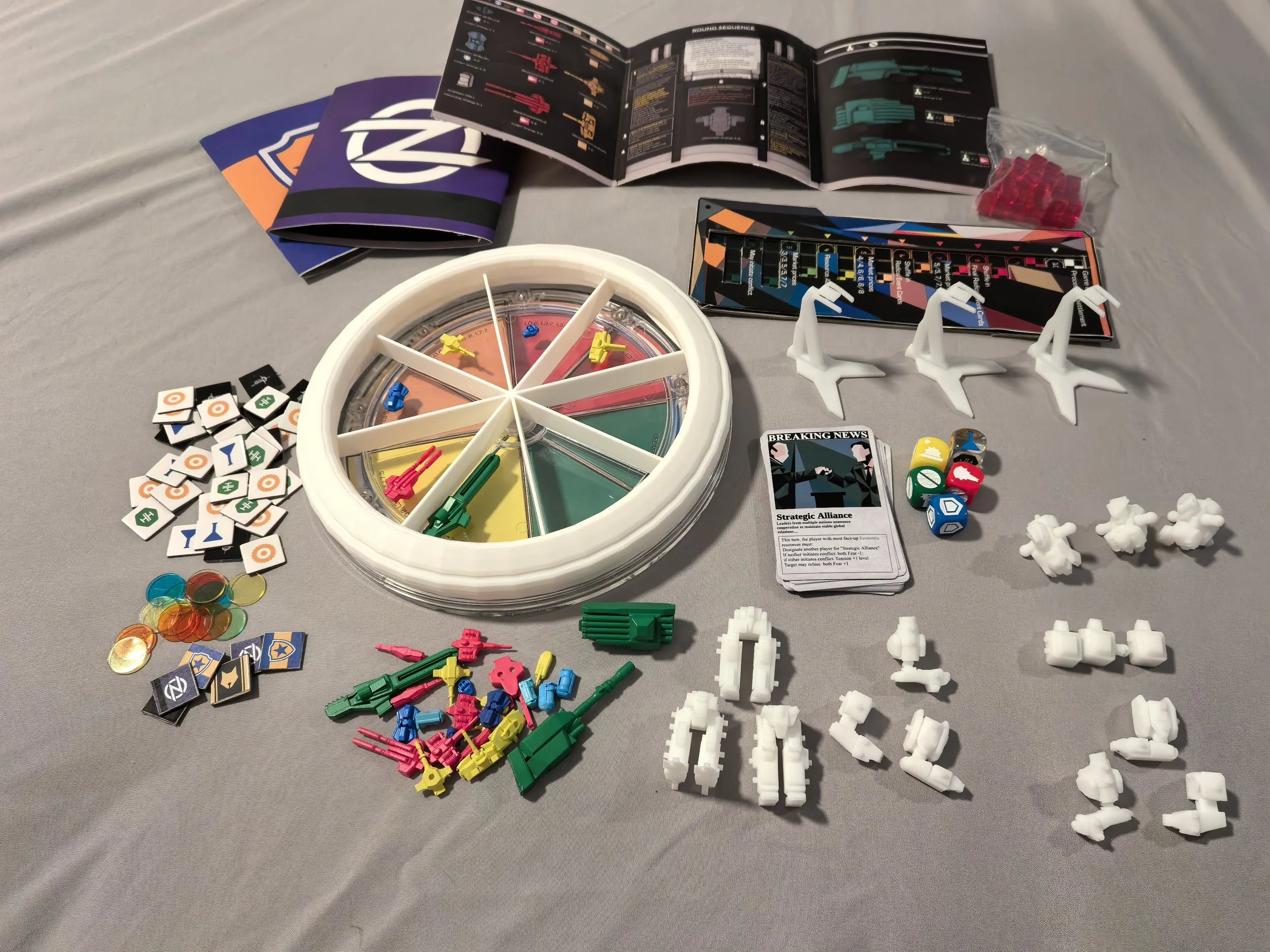
Zero Meridian is a 3-player Cold War mech strategy board game. On a parallel Earth, three major alliances are locked in an arms race stalemate. A mysterious military corporation monopolizes mech technology, forcing nations to assemble their war machines by bidding for components. Players assume the role of alliance leaders, tasked with accomplishing three objectives under resource scarcity: scrambling to purchase parts for mech assembly, managing domestic fear levels, and initiating combat at opportune moments.
On the surface, it's a strategy game about mech assembly and Cold War rivalry, but at its core, it's an interactive satire on the absurdity of the arms trade. Players don't take on the role of heroes, but rather puppets manipulated by an arms corporation—you're pitted against each other, yet all buying weapons from the same seller. I want to create an allegory for real-world multinational arms corporations—they maintain “neutrality” in wars because they sell to everyone.
features
BIDDING
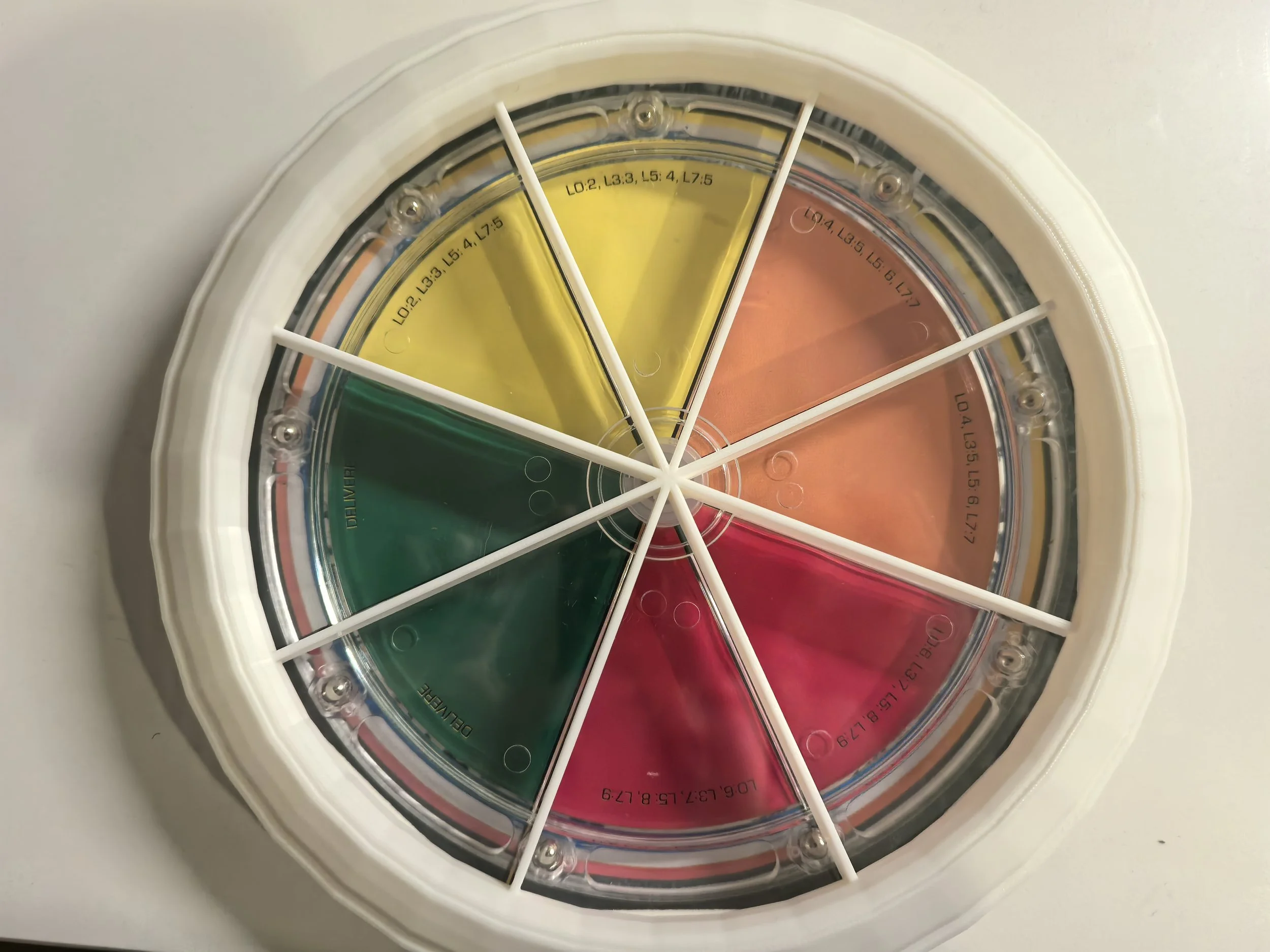
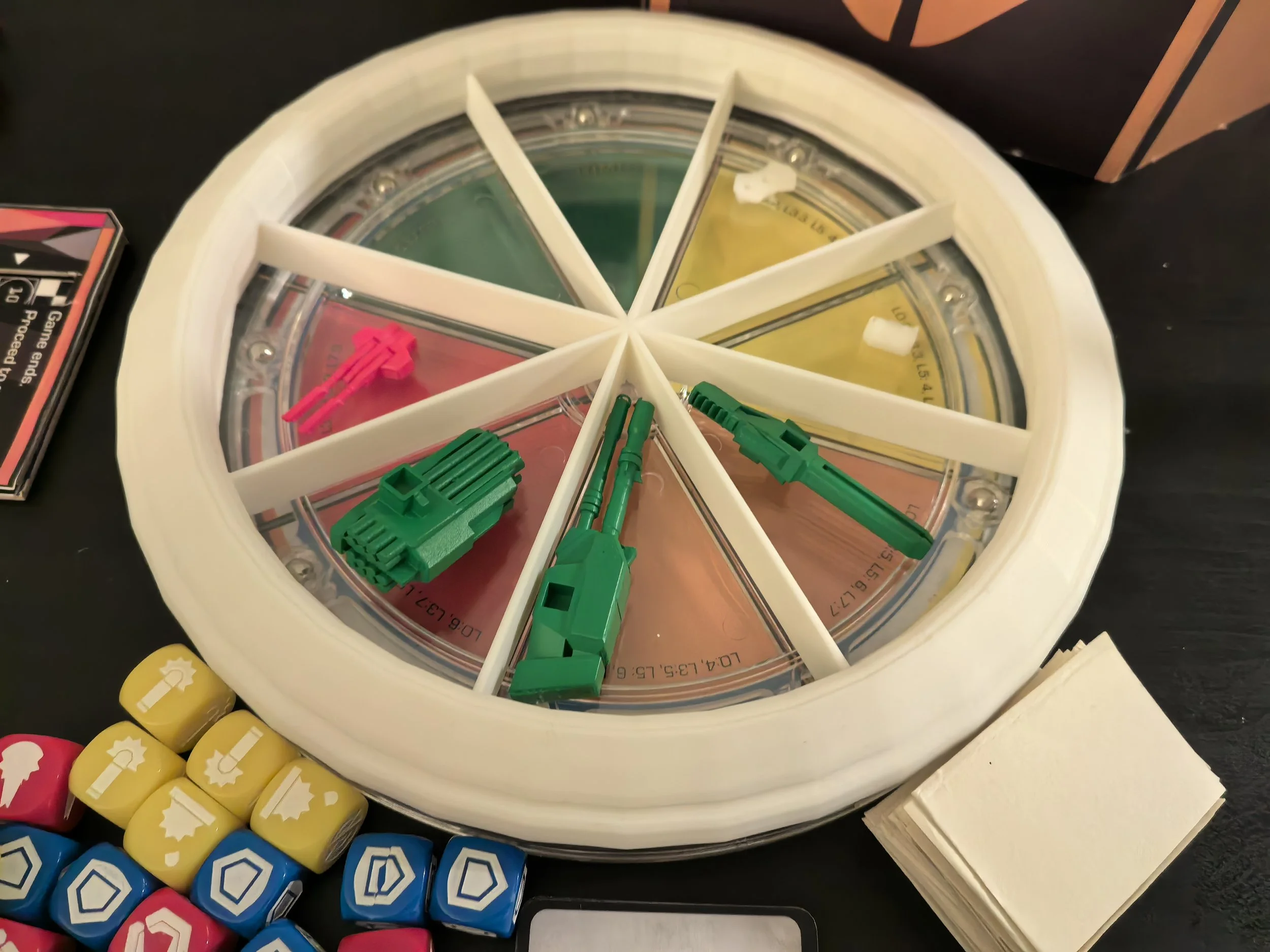
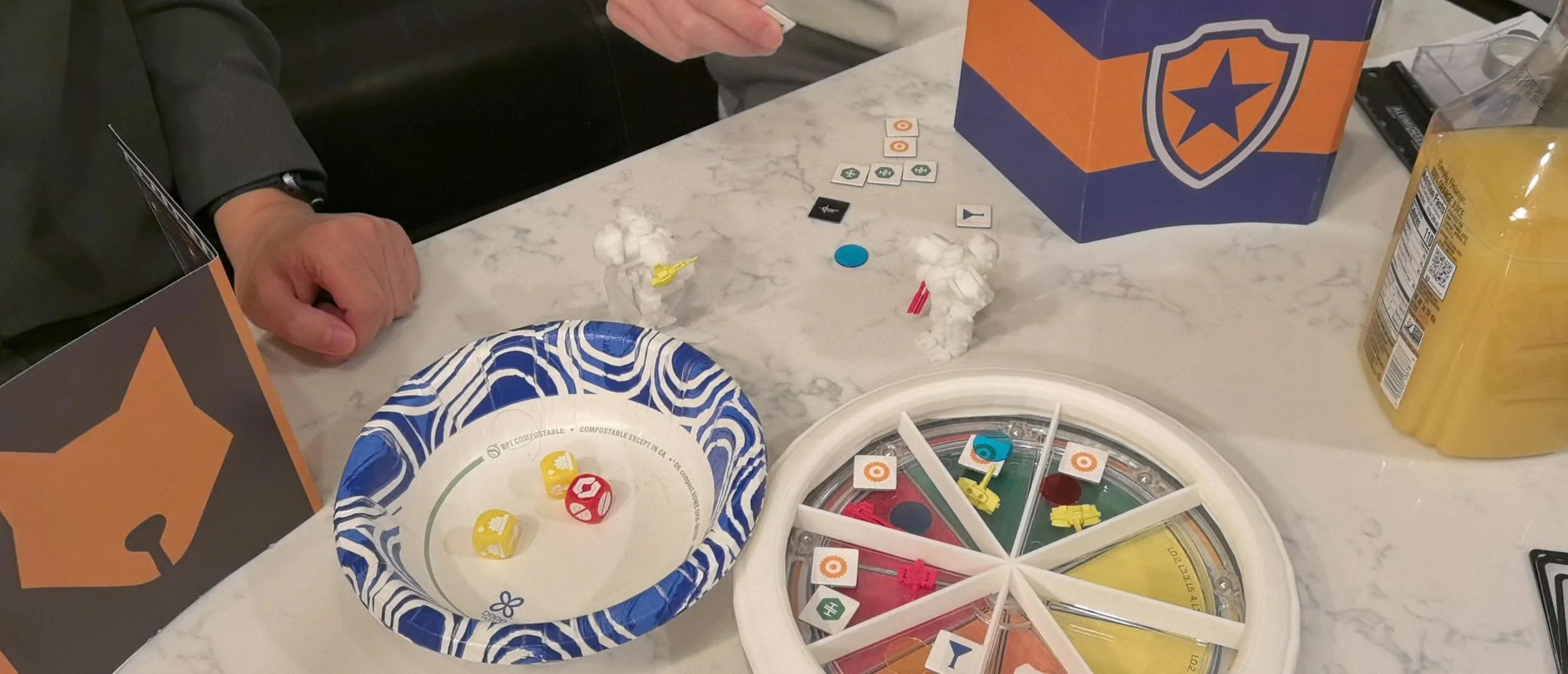
The game centers around an 8-slot rotating wheel. Players place resources on wheel slots to reserve parts. The wheel spins each turn, and orders are fulfilled only when they reach the delivery slot. Long-term orders are cheaper but take longer, while rush orders are pricier but faster—timing and price negotiations create constant psychological warfare. Other players can outbid you for reserved parts, but this raises the overall tension level.
resource management
Each of the three resources serves distinct battlefield purposes: Economy can reduce opponents' attack dice before combat, Industry allows re-rolls to turn the tide during combat, and Technology can repairs damaged components after every combat. Resources aren't just purchasing power—they're critical tactical assets in battle.
Assembly
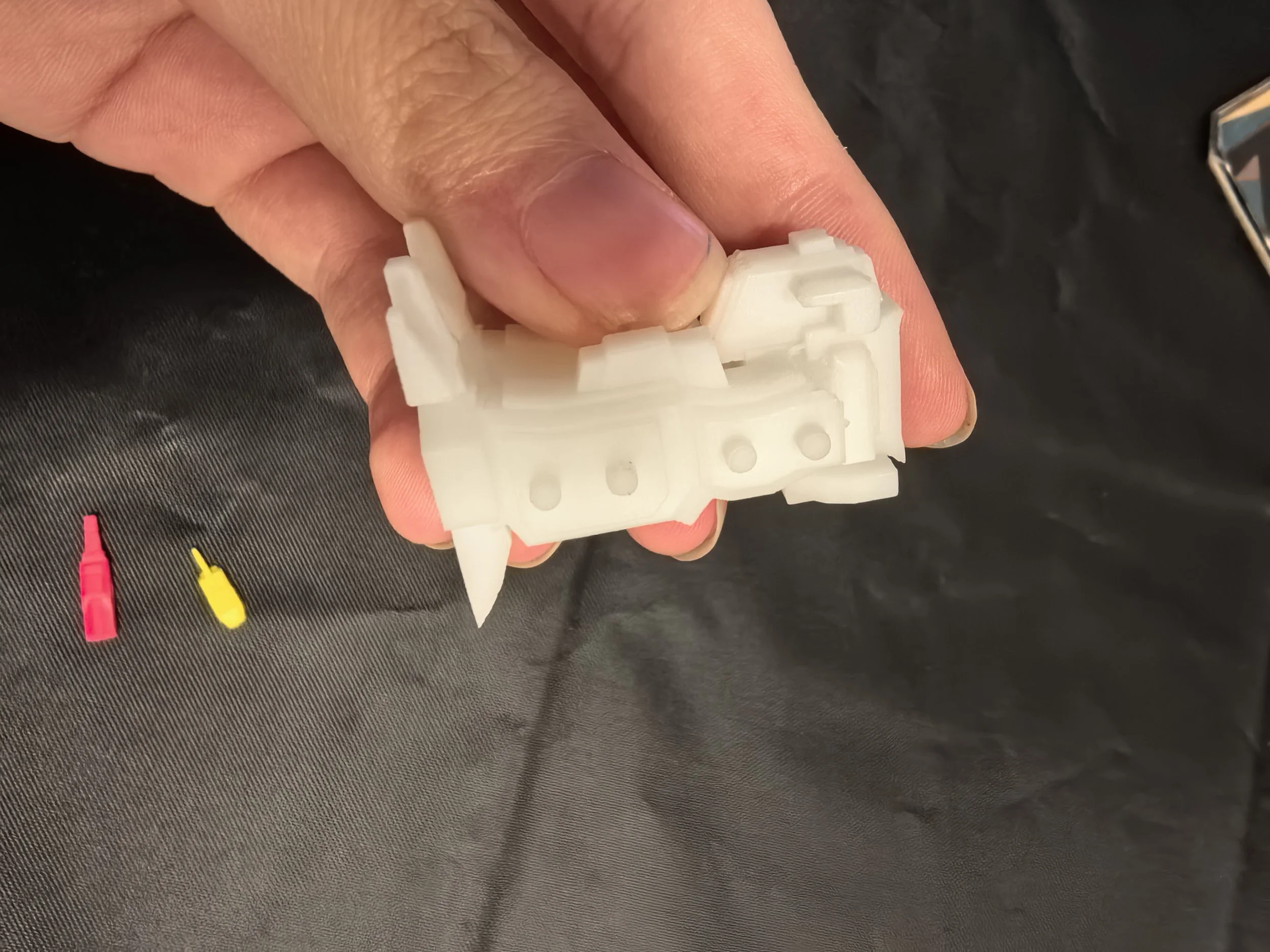
Assembly is arguably one of the most crucial elements in this game. Different pieces of equipment feature distinct holes, and some equipment may obstruct adjacent pieces. Therefore, how players install these components during gameplay is of paramount importance.
fear
Fear serves as the game's survival threshold. It functions as a universal resource, but exceeding the current tension level instantly eliminates the player. Risk-takers can gain resource advantages through fear, while overly cautious players may fall behind in the arms race.
tension
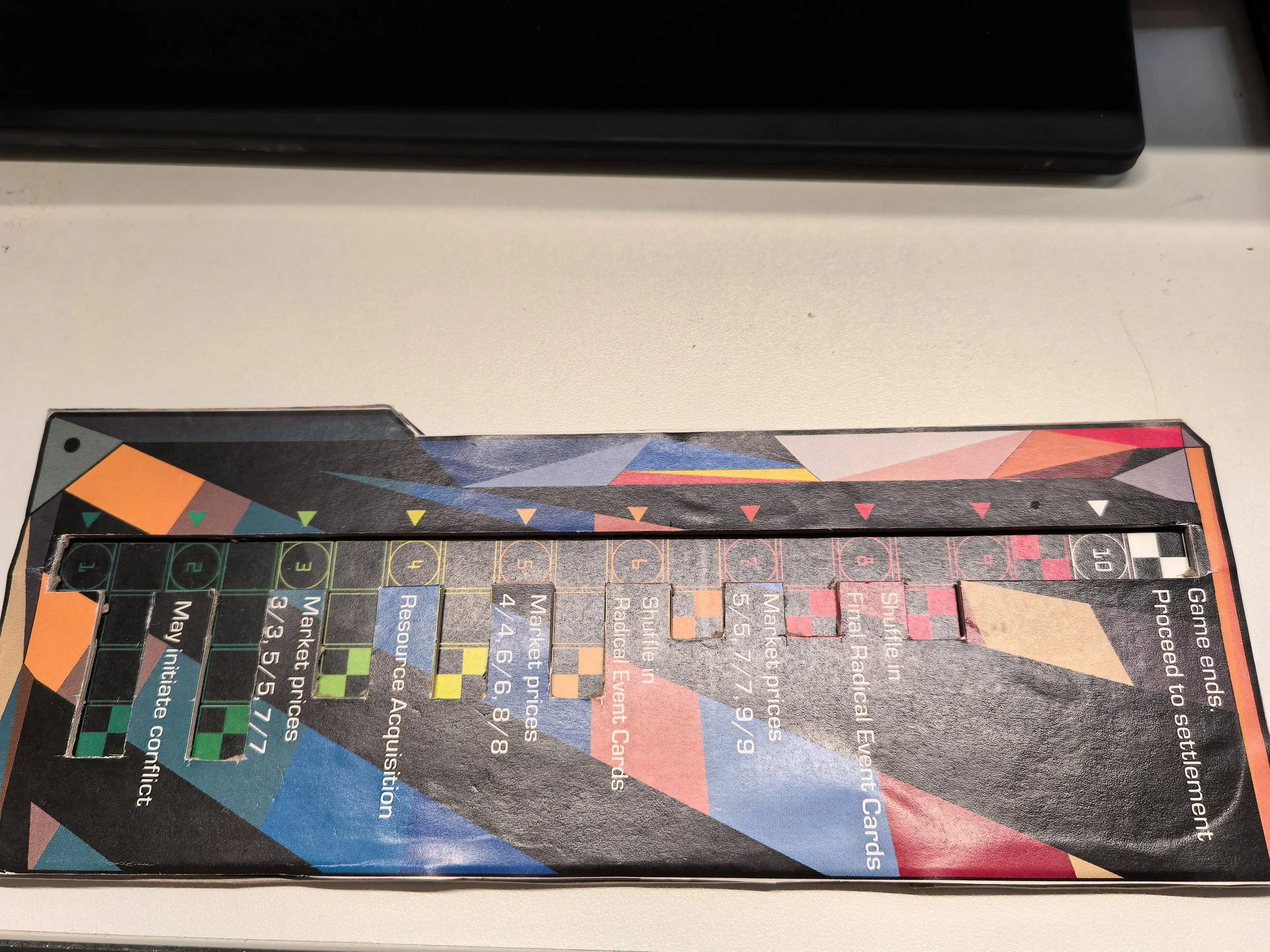
Global tension is collectively driven by player actions: shipping, bidding, and combat all accumulate threats. Escalating tension unlocks combat options, drives up prices, and shuffles in more aggressive event cards. The game's pace isn't predetermined—it's the result of a three-way strategic interplay.
Motivation and inspiration
This project was born from my dual passion for mecha culture and model making. As a model enthusiast, what I cherish most isn't the moment the finished piece sits on the shelf, but the gradual sense of fulfillment during assembly—opening the parts bag, carefully examining each component's design, contemplating how to assemble them, and finally piecing them together into a complete work with my own hands. This journey “from parts to whole” is filled with the joy of choice, planning, and creation.
I've long wondered: Could this model-building experience be transformed into the core mechanic of a tabletop game? Traditional mecha tabletop games often focus solely on combat, treating unit configuration as merely a pre-battle preparation phase. But I envisioned a game where “assembling the mech” itself becomes the core gameplay—players don't start with a complete unit but instead compete for parts, balance resources, and gradually build their own war machine throughout the game. This process should be tense, strategic, and filled with that “finally got the part that I need” sense of accomplishment.
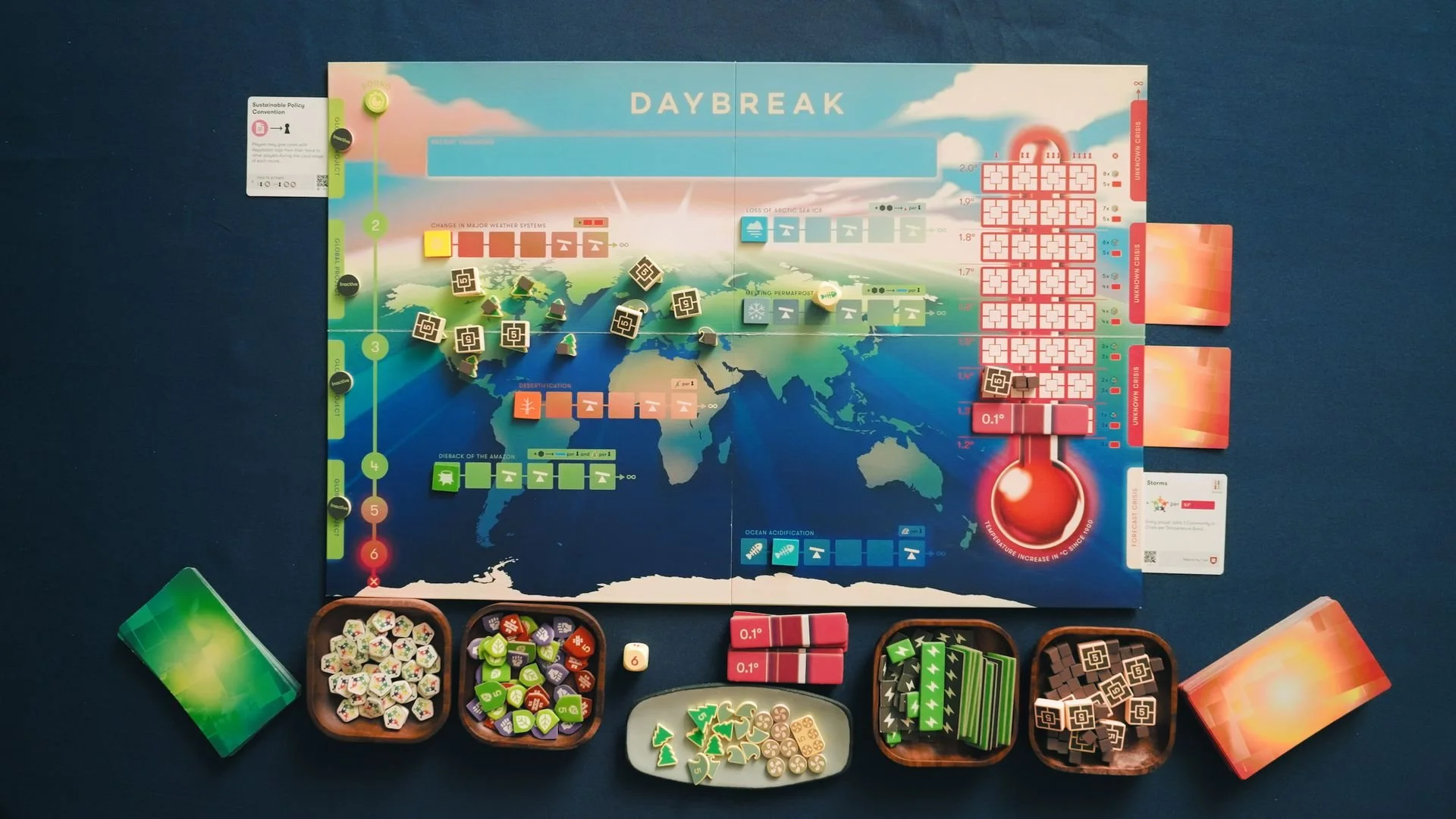
Daybreak (Designers: Matt Leacock & Matteo Menapace)
Publisher: CMYK, Release Year: 2023
I drew inspiration from its progress bar system, adapting it into Zero Meridian's tension mechanism. The difference lies in the source of pressure: here, it's not a shared enemy, but the cumulative result of every player's actions—each order, each battle propels the world toward its final chapter. This sensation of “dancing on the edge of a knife” perfectly captures the essence of the Cold War era.
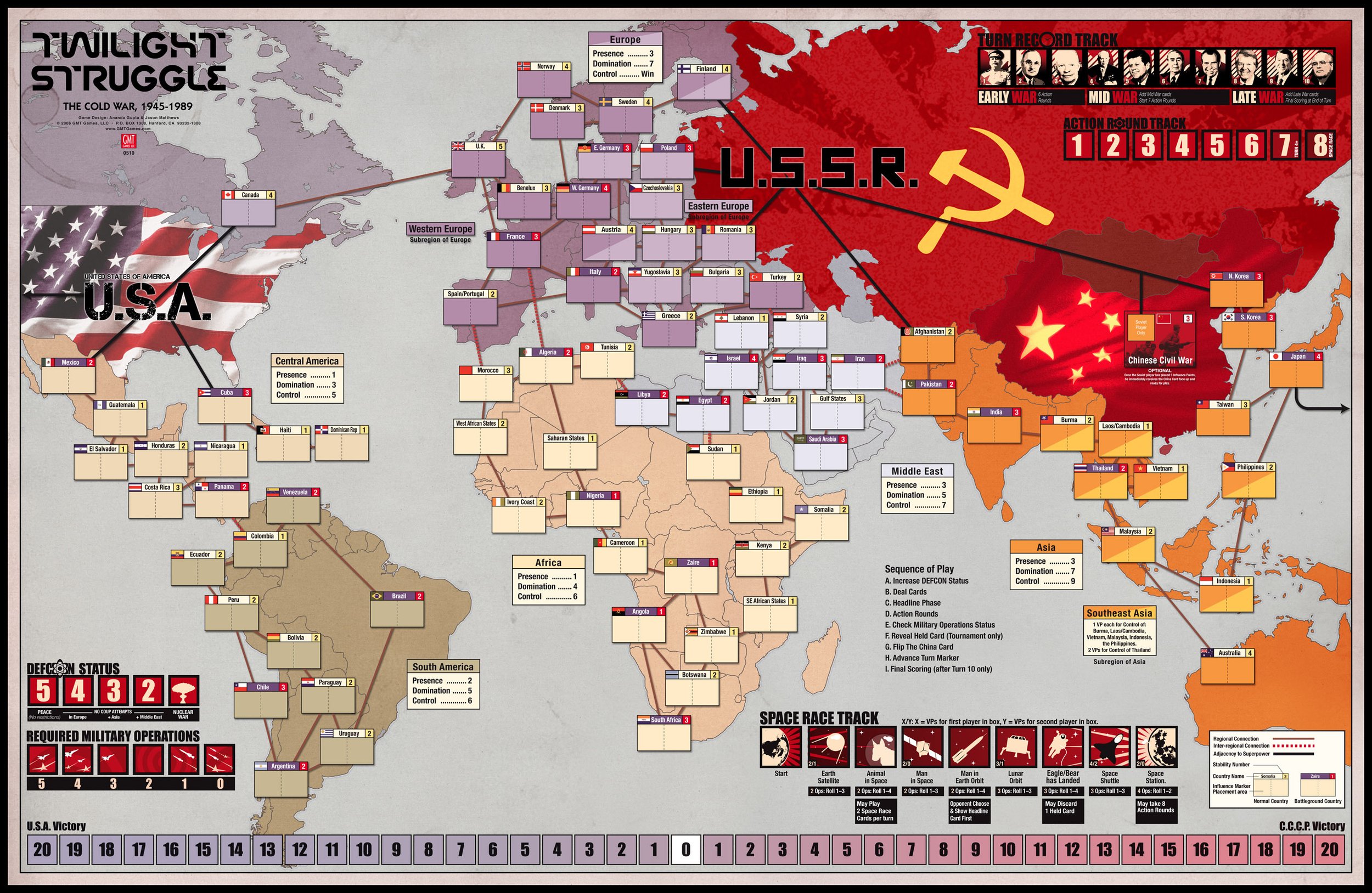
Twilight Struggle (Designers: Ananda Gupta & Jason Matthews)
Publisher: GMT Games, Year of Publication: 2005
I studied its three-player dynamics and event-driven design. The three alliances compete yet may form coalitions, embodying the adage that “today's ally may be tomorrow's enemy.”
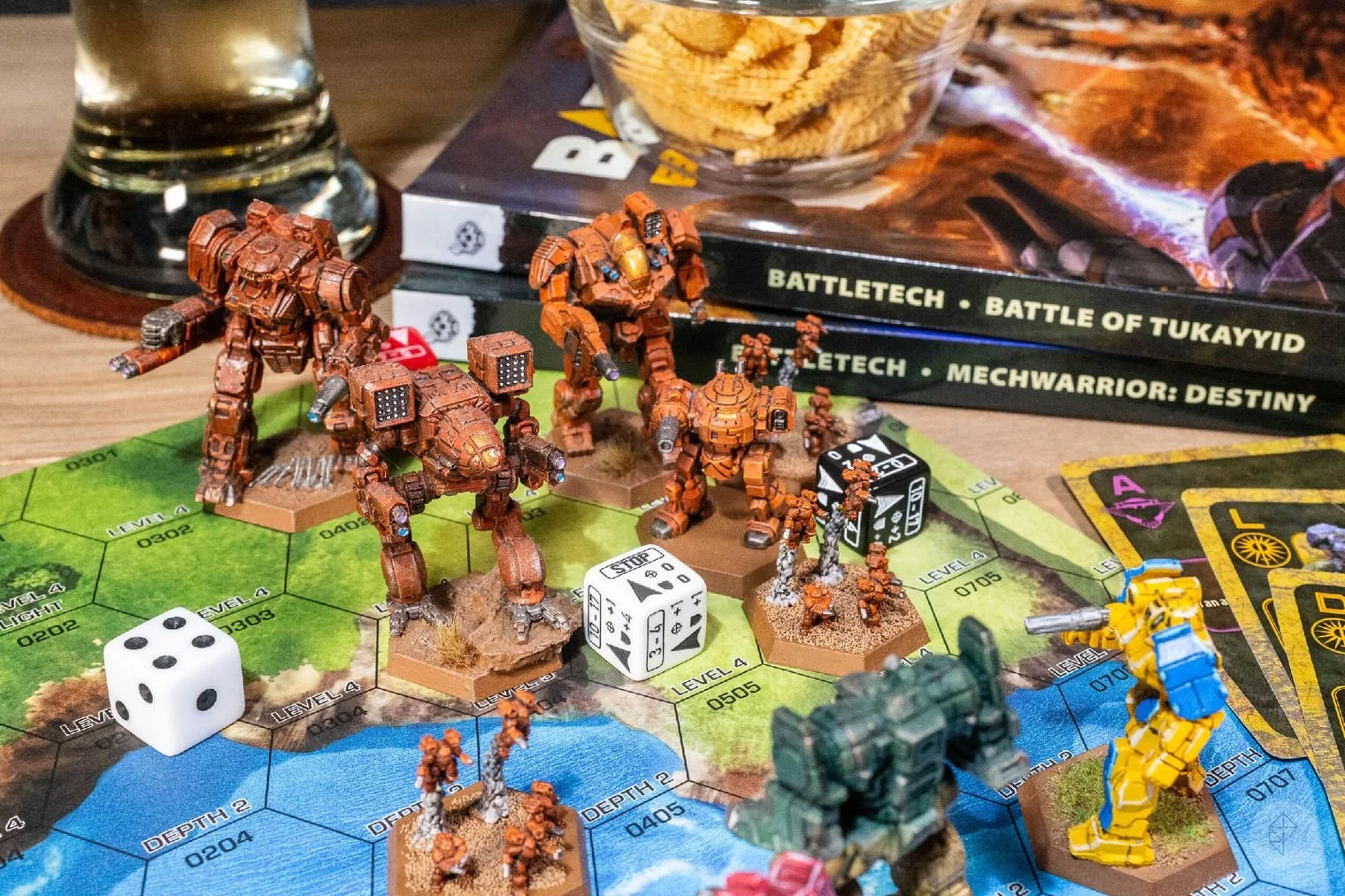
Battletech (Jordan Weisman & L. Ross Babcock III )
Publisher: FASA Corporation, Release Year: 1984
I've learned much from their mech design philosophy but simplified the complexity. My pursuit is the “joy of assembly” when players secretly assemble their mechs behind the curtain, then reveal the mystery on the battlefield. This process of “secret assembly → public showdown” mirrors the moment when model enthusiasts unveil their completed creations.
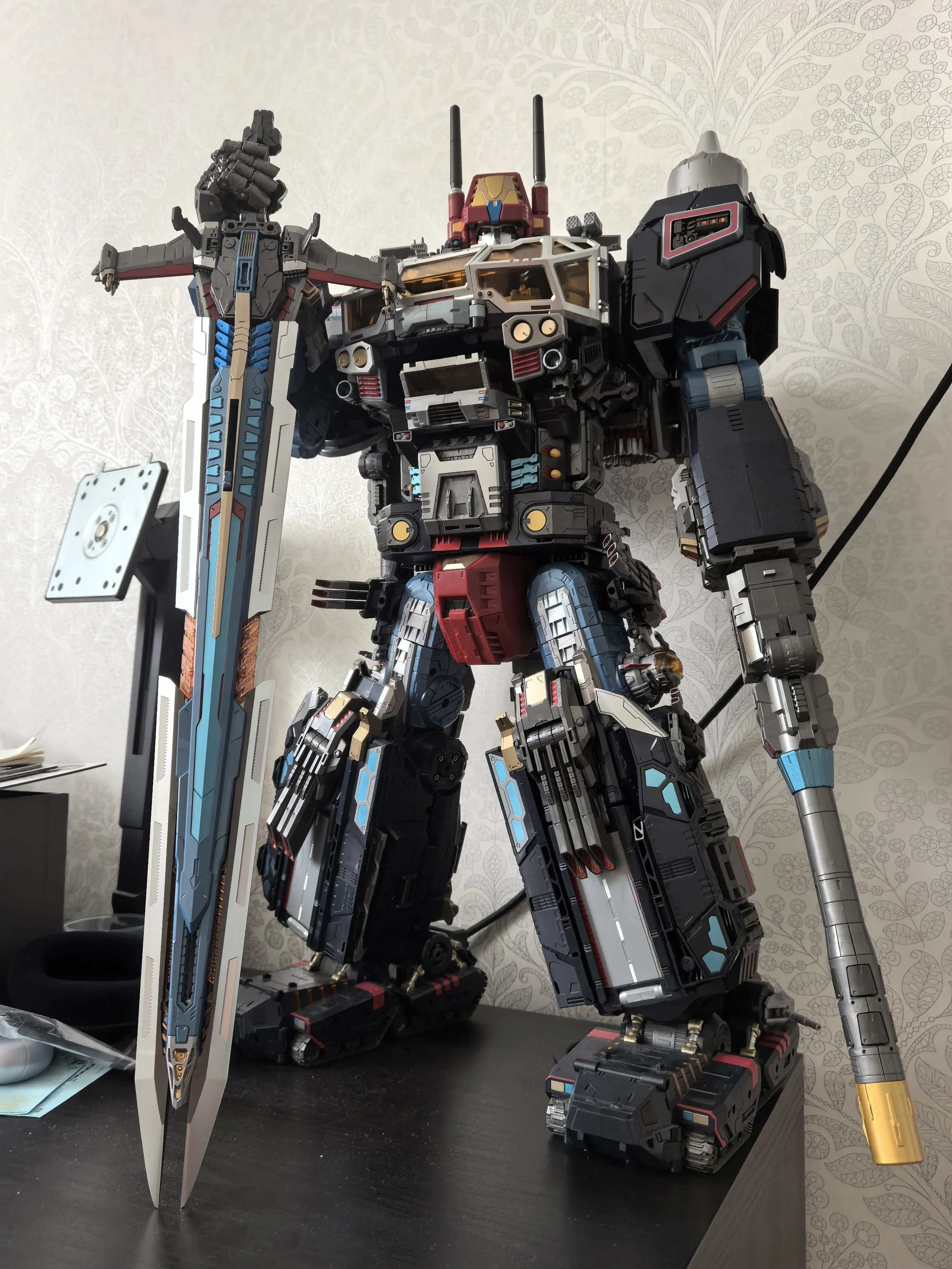
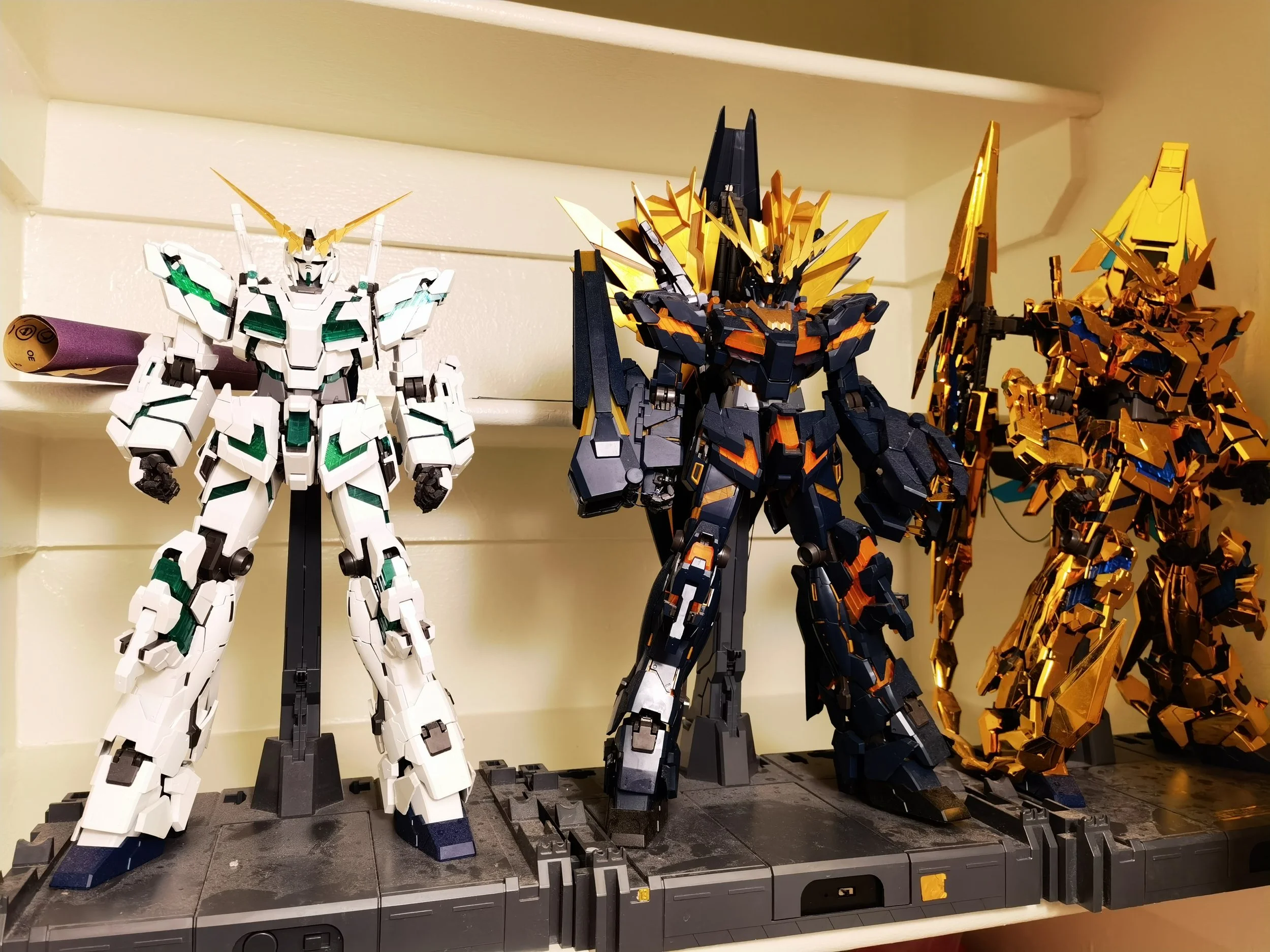
Some of my collections
SETUP
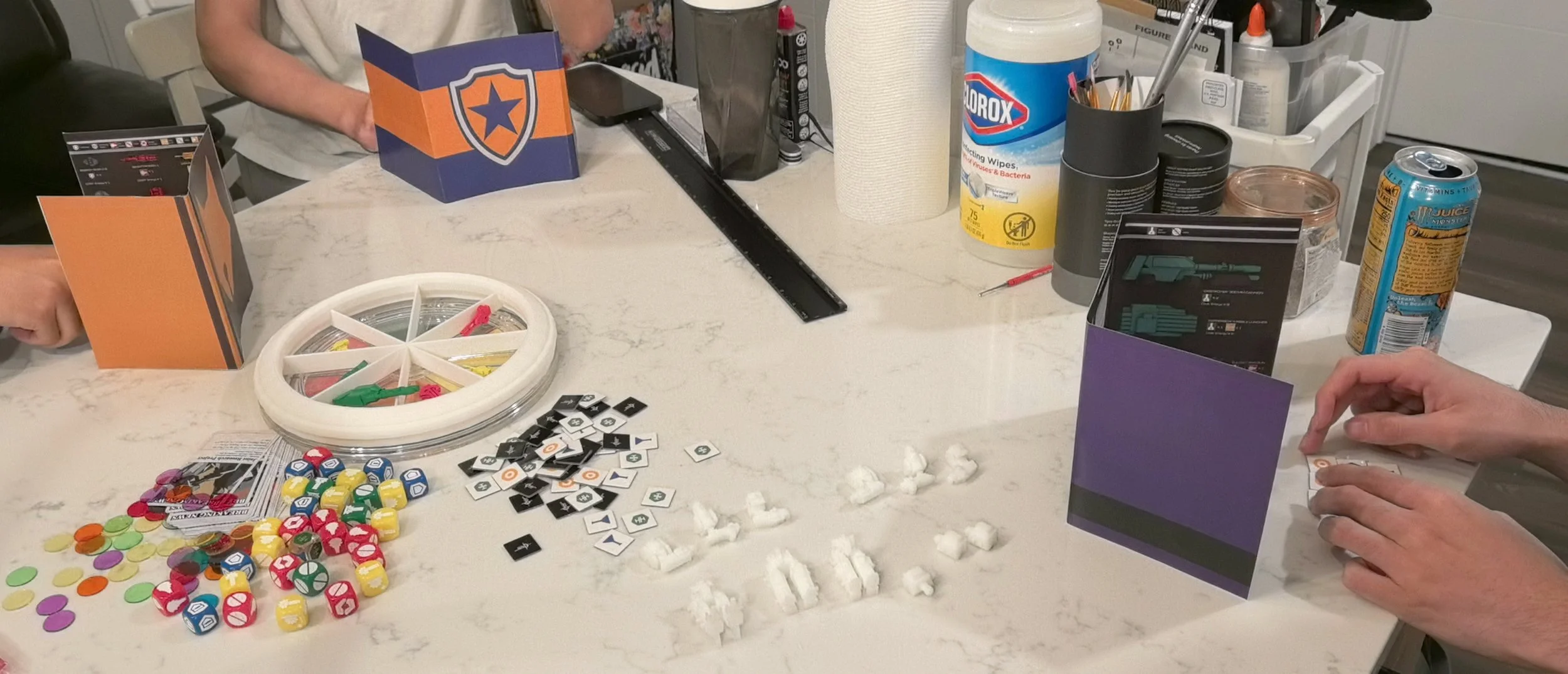
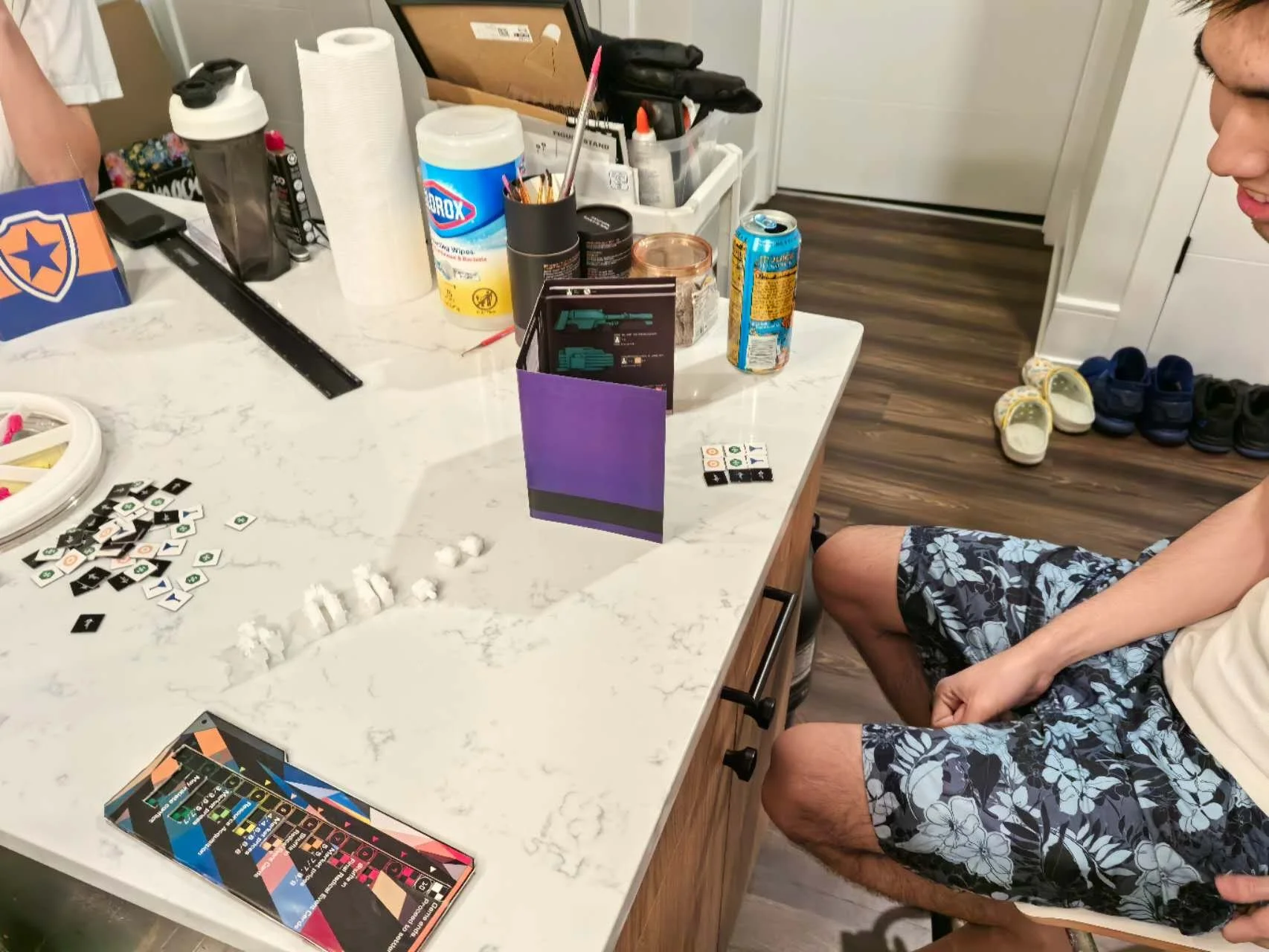
At the start of the game, each player selects a Mech Core (consisting of a core and a frame, differing only in appearance).
Each player takes 3 tokens each of the “Economy,” “Industry,” and “Technology” resources.
Take 6 random equipment pieces from the equipment bag and place them on the wheel.
Bidding begins in the following order: left arm, right arm, legs, backpack. Players secretly bid any number of resources from their supply (including zero). The highest bidder selects the equipment first. Simultaneously, flip the contributed resources face-down to indicate they're spent for this phase. If two players bid the same amount, they secretly bid again. If still tied, resolve the order using rock-paper-scissors. Repeat this process until every player has acquired one core, two arms (left and right), one lower limb, and one backpack.
However, be mindful not to exhaust all resources, as the order for the official game's initial resource grab will be determined by comparing the amount of resources each player has.
Assemble a basic mech and place it behind the screen.
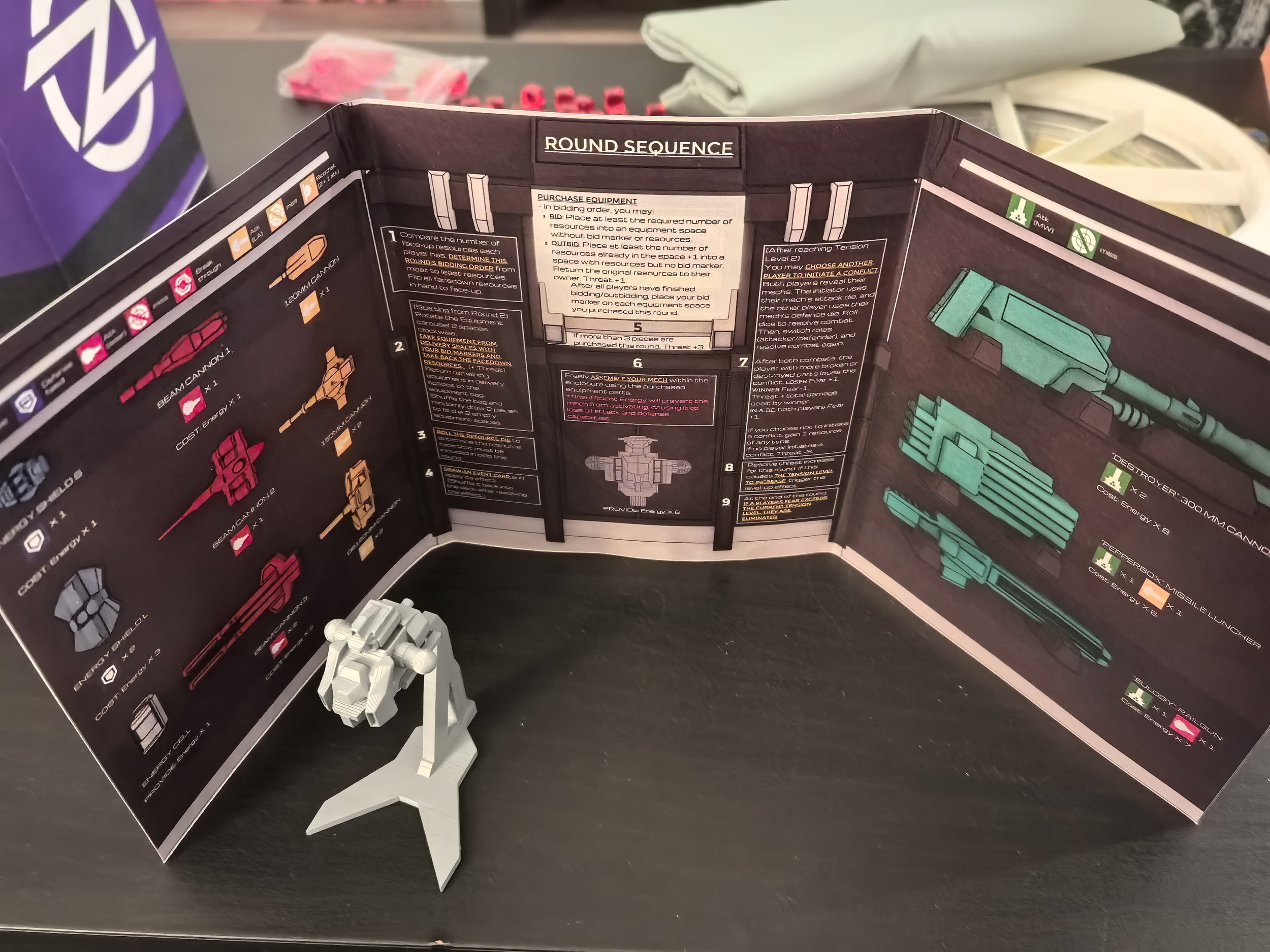
Round Sequence
-
![]()
1
Compare the number of face-up resources each player has. Determine this round bidding order from most to least resources.
Flip all facedown resources in hand to face-up.
-
![]()
2
(Starting from Round 2)
Rotate the Equipment carousel 2 spaces clockwise.
Take equipment from delivery spaces with your bid markers and take back the facedown resources. (+ Threat)Return remaining equipment in delivery spaces to the equipment bag.
Shuffle the bag and randomly draw 2 pieces to fill the 2 empty equipment spaces. -
![]()
3
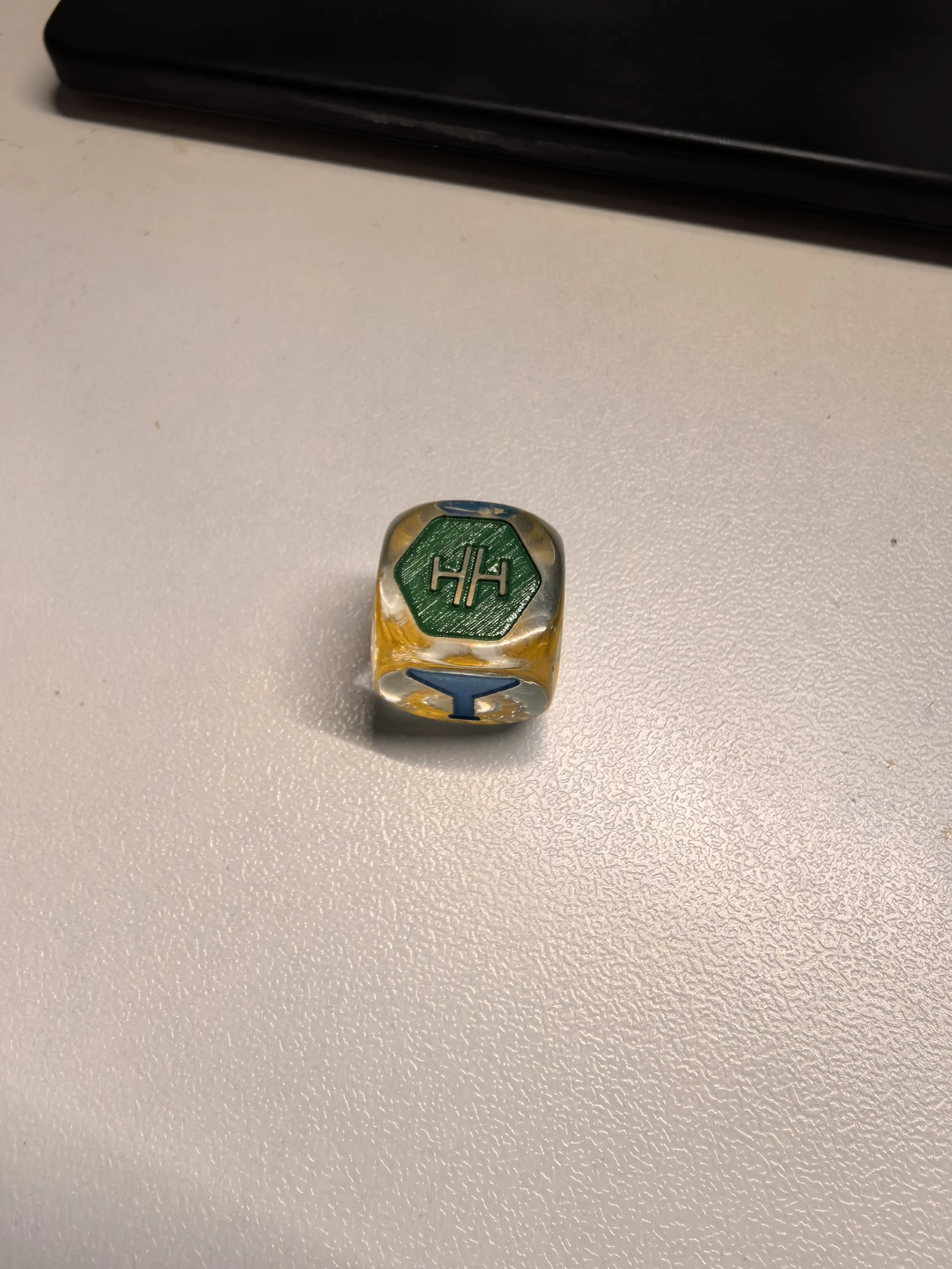
Roll the resource die to determine the resource type that must be included in bids this round.
-
![]()
4
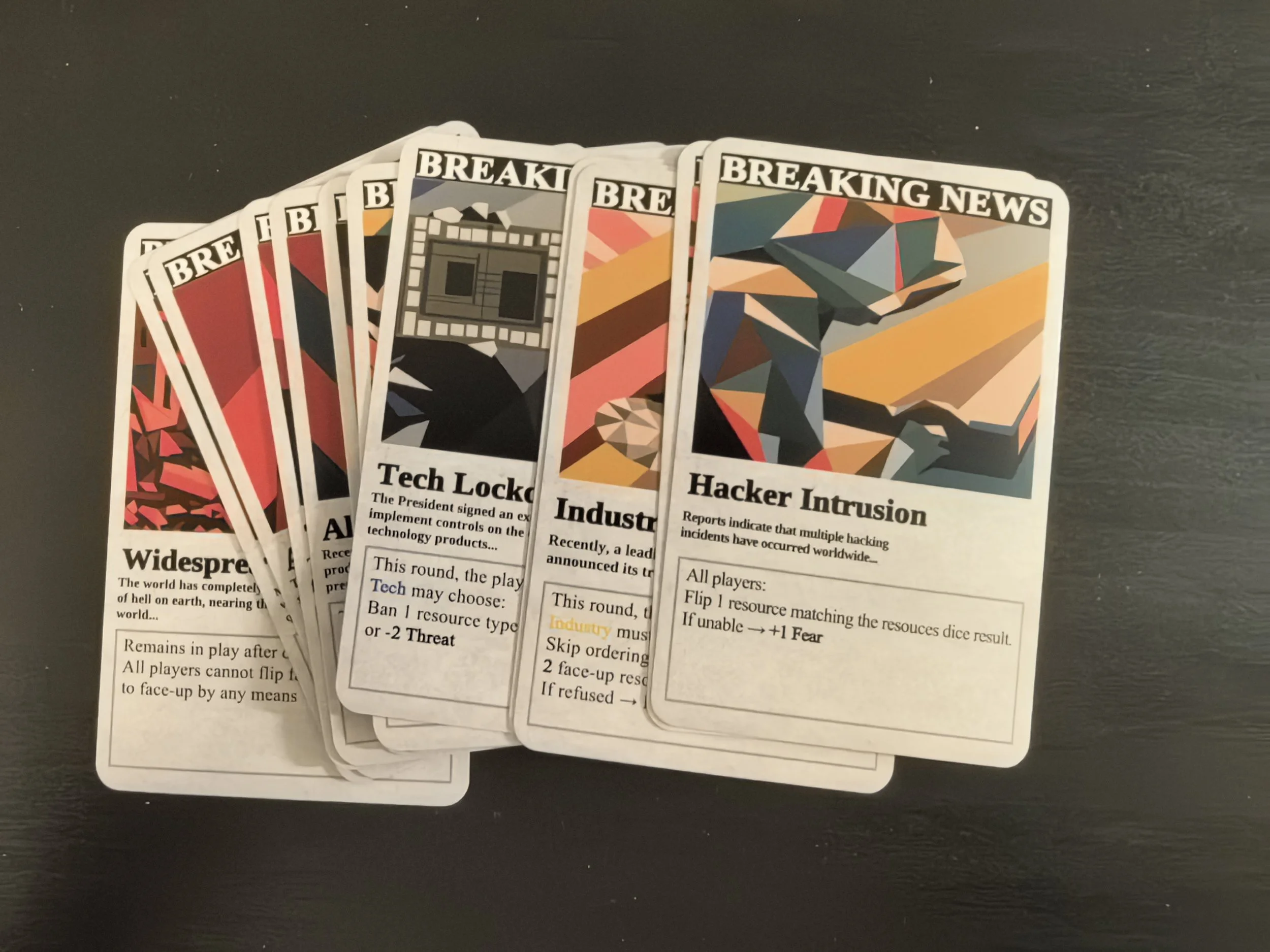
Draw an event card and apply its effect. (Starting from round 2)
(Shuffle it back into the deck after resolving the effect.) -
![]()
5
Purchase Equipment
- In bidding order, you may:Bid: Place at least the required number of resources into an equipment space without bid marker or resources.
Outbid: Place at least the number of resources already in the space +1 into a space with resources but no bid marker. Return the original resources to their owner. Threat +1.
If more than 3 pieces are purchased this round, Threat +3.
-
![]()
6
Freely assemble your mech within the enclosure using the purchased equipment parts. **Insufficient Energy will prevent the mech from activating, causing it to lose all attack and defense capabilities.
-
![]()
7
(After reaching Tension Level 2)
You may choose another player to initiate a conflict. Both players reveal their mechs. The initiator uses their mech's attack dice, and the other player uses their mech's defense dice. Roll dice to resolve combat. Then, switch roles (attacker/defender), and resolve combat again.
After both combats, the player with more broken or destroyed parts loses the conflict: loser Fear +1, winner Fear-1.
Threat + total damage dealt by winner.
In a tie, both players Fear +1.
If you choose not to initiate a conflict, gain 1 resource of any type.
If no player initiates a conflict, Threat -2. -
![]()
8
Resolve threat increase for this round. If this causes the Tension Level to increase, trigger the level-up effect.
-
![]()
9
At the end of the round, if a player's Fear exceeds the current Tension Level, they are eliminated.
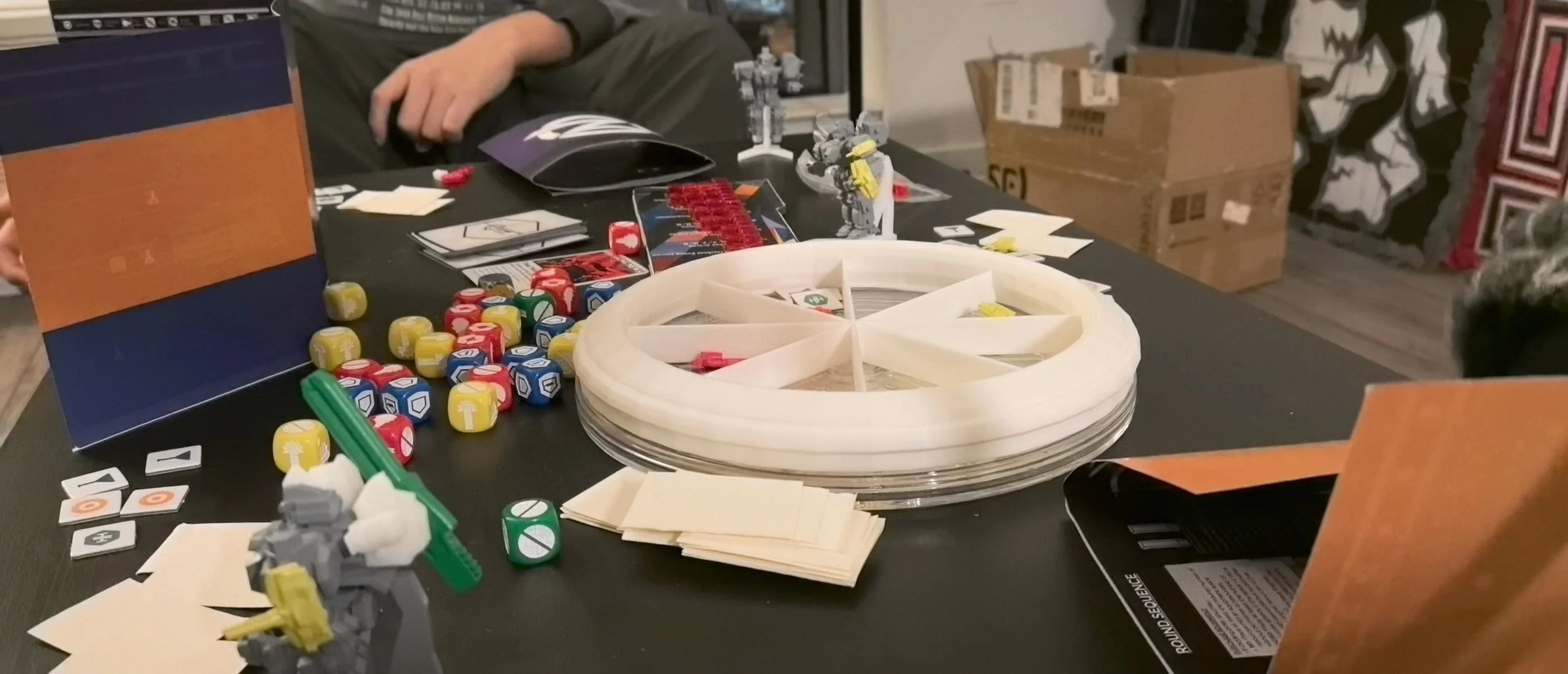
ASSEMBLY
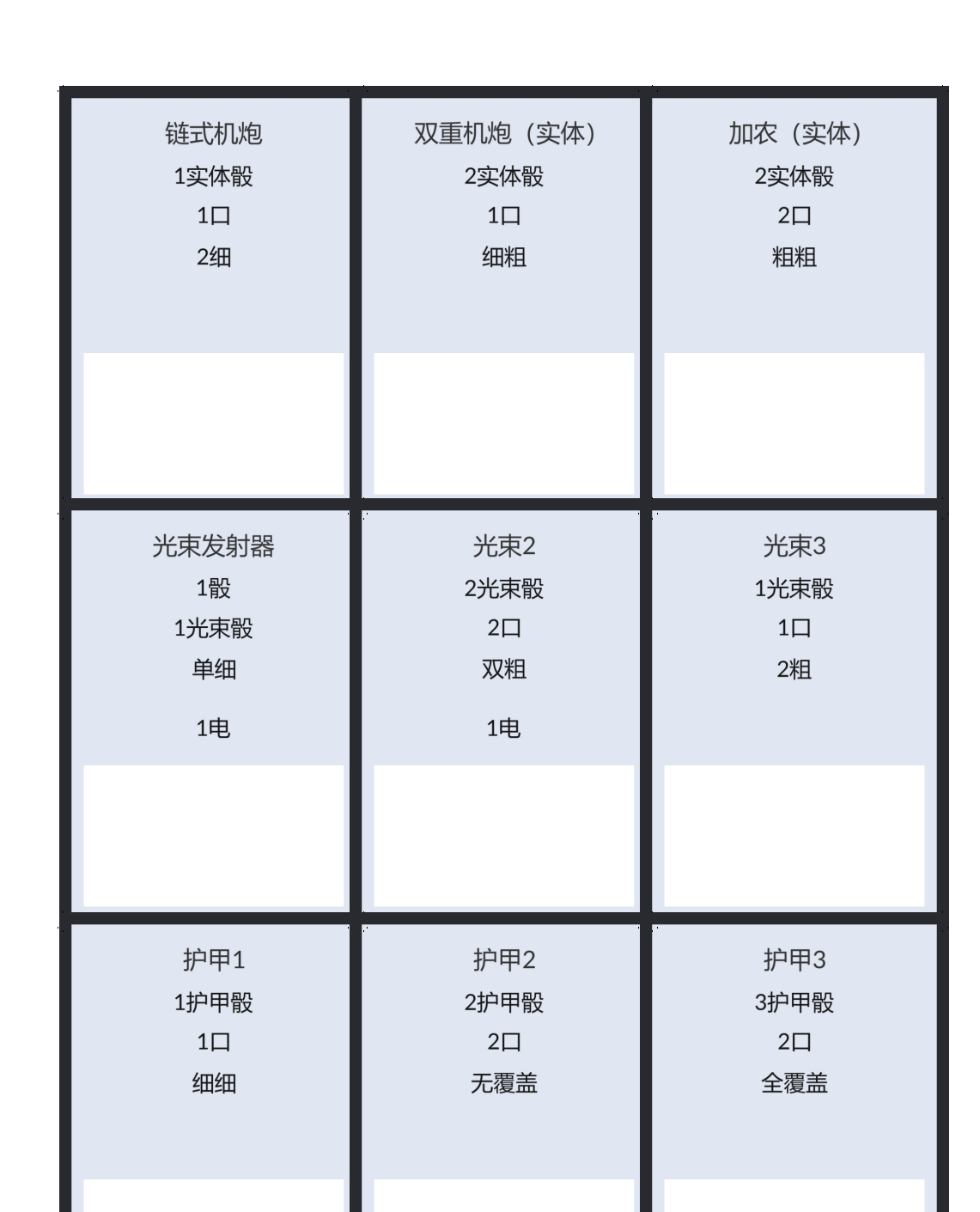
Equipment in the game varies in size, and the number of holes they possess differs. Furthermore, they feature different occlusion relationships—you might install a weapon with one hole, but it could block an adjacent mounting joint. 👇
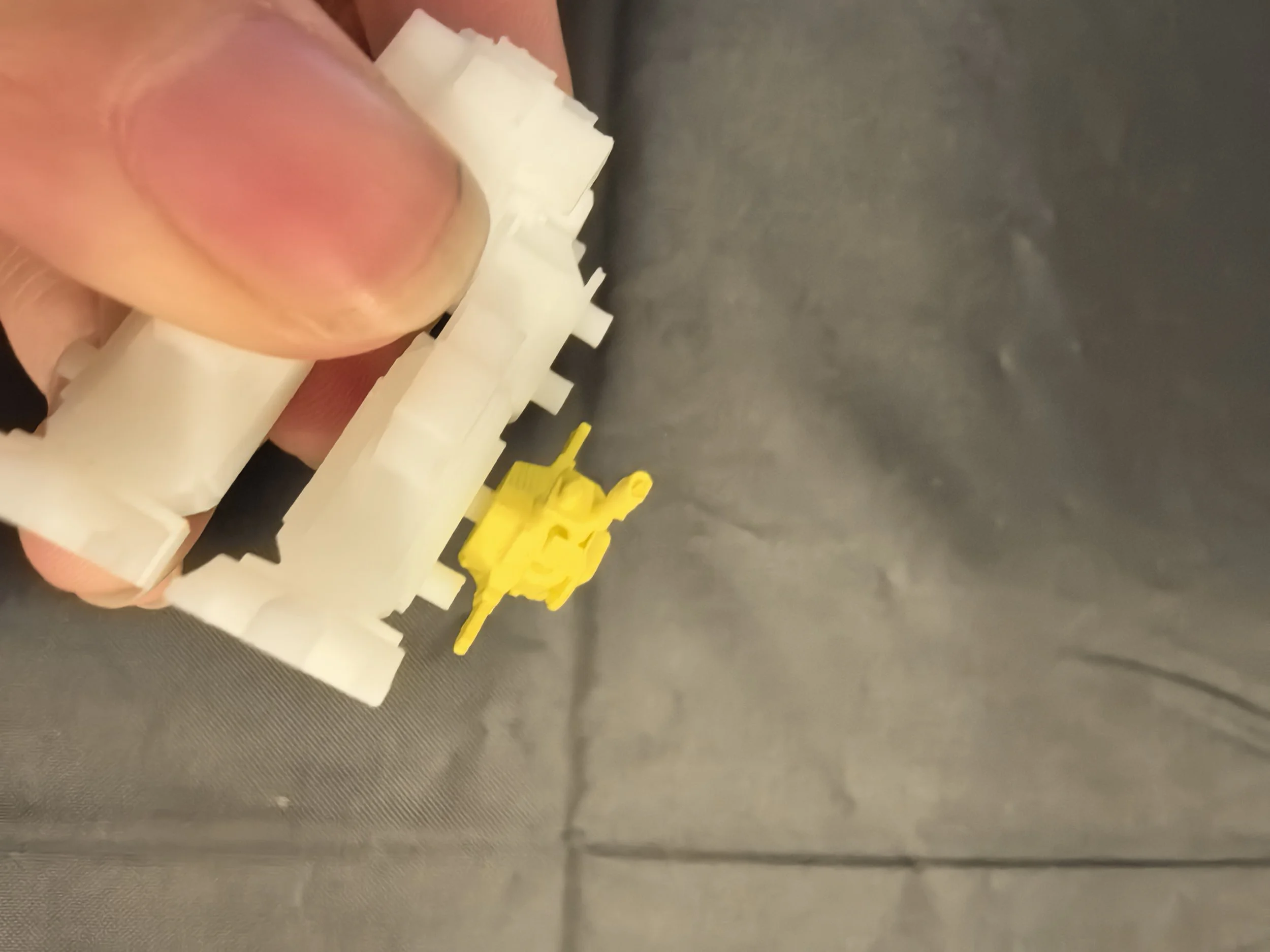
Or you can mount two small weapons that only require one joint each.
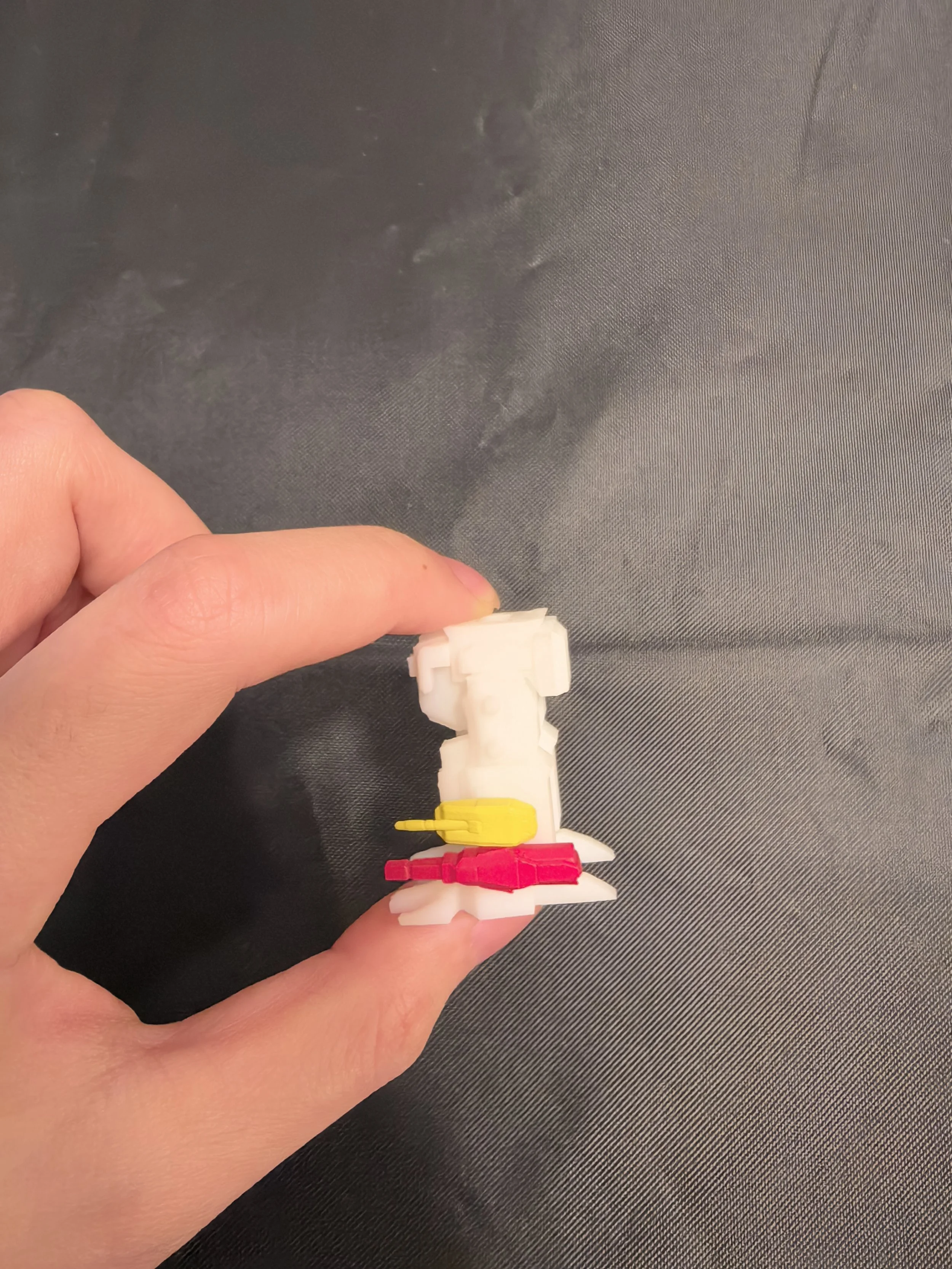
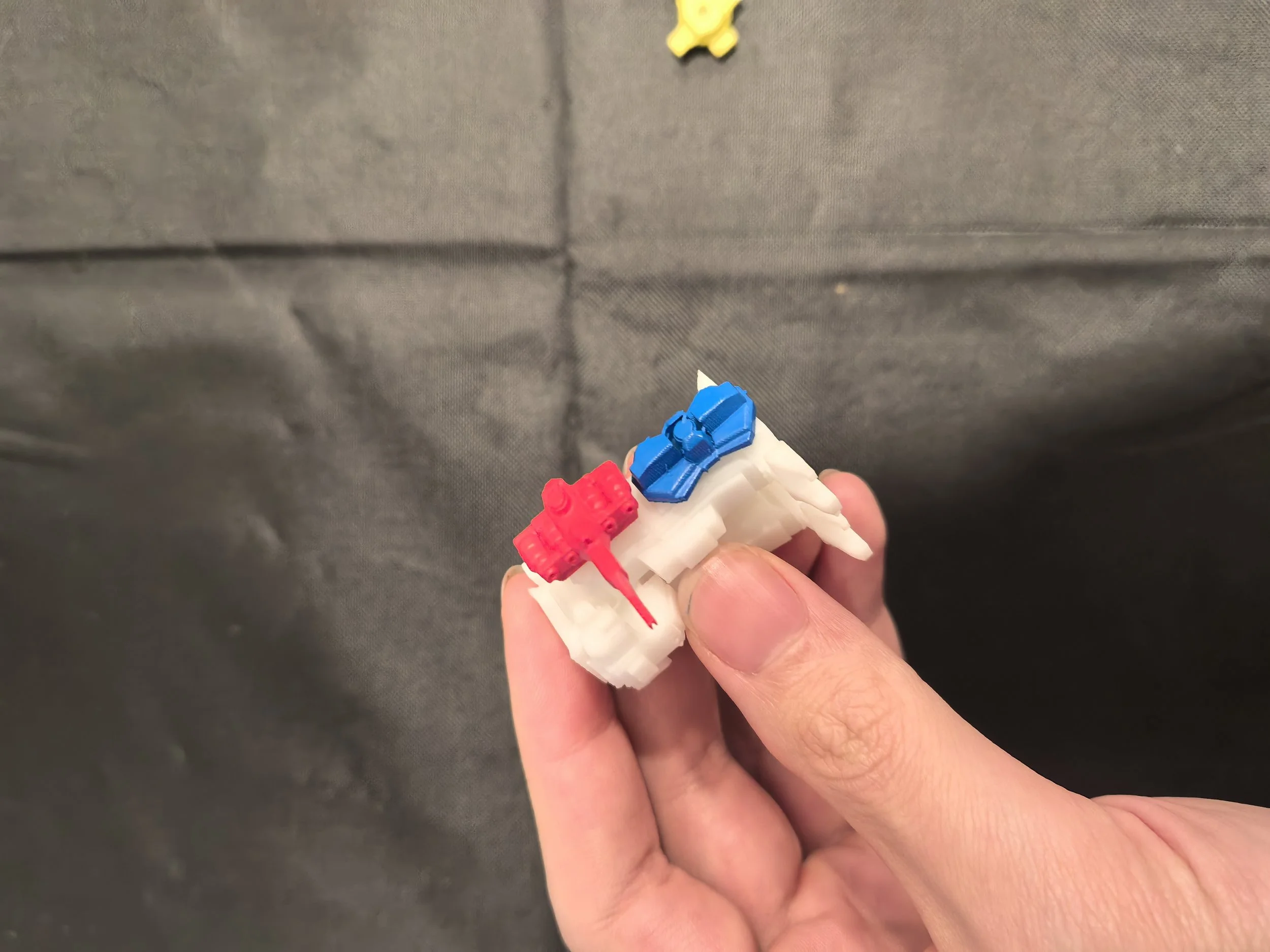
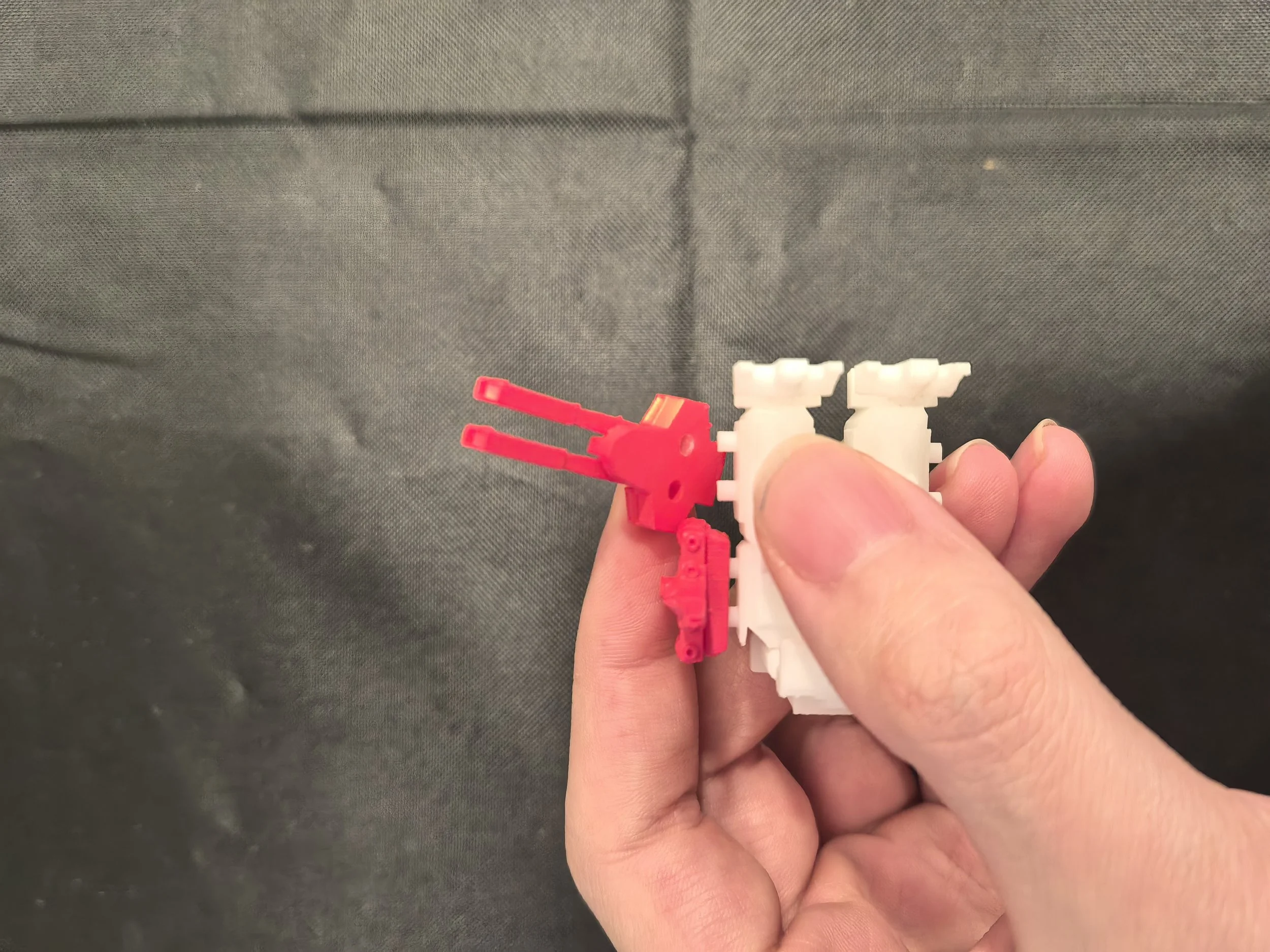
Although these are all two-hole equipment, some may interfere with other two-hole equipment, while others do not. Therefore, how they are allocated is also crucial.
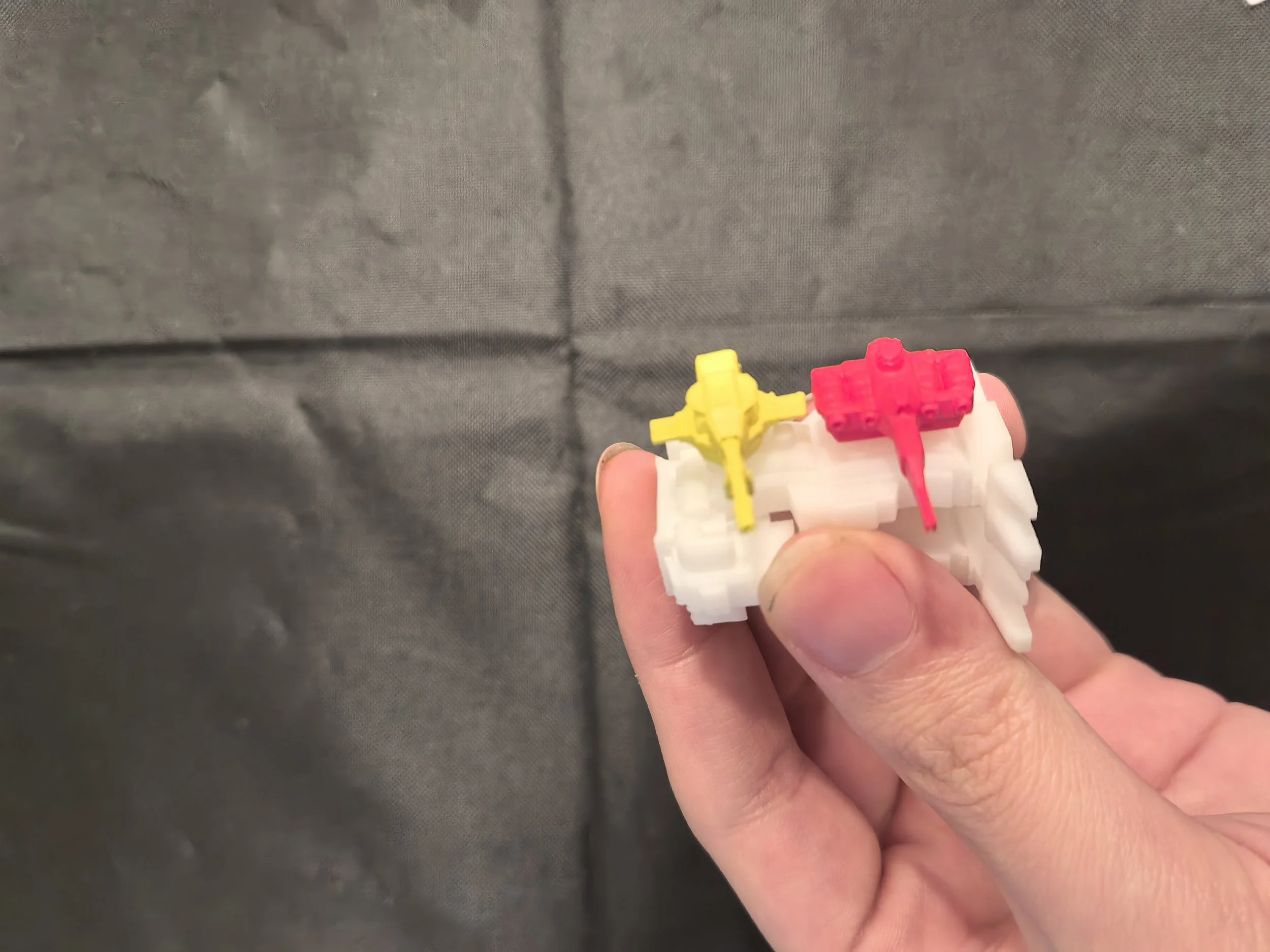
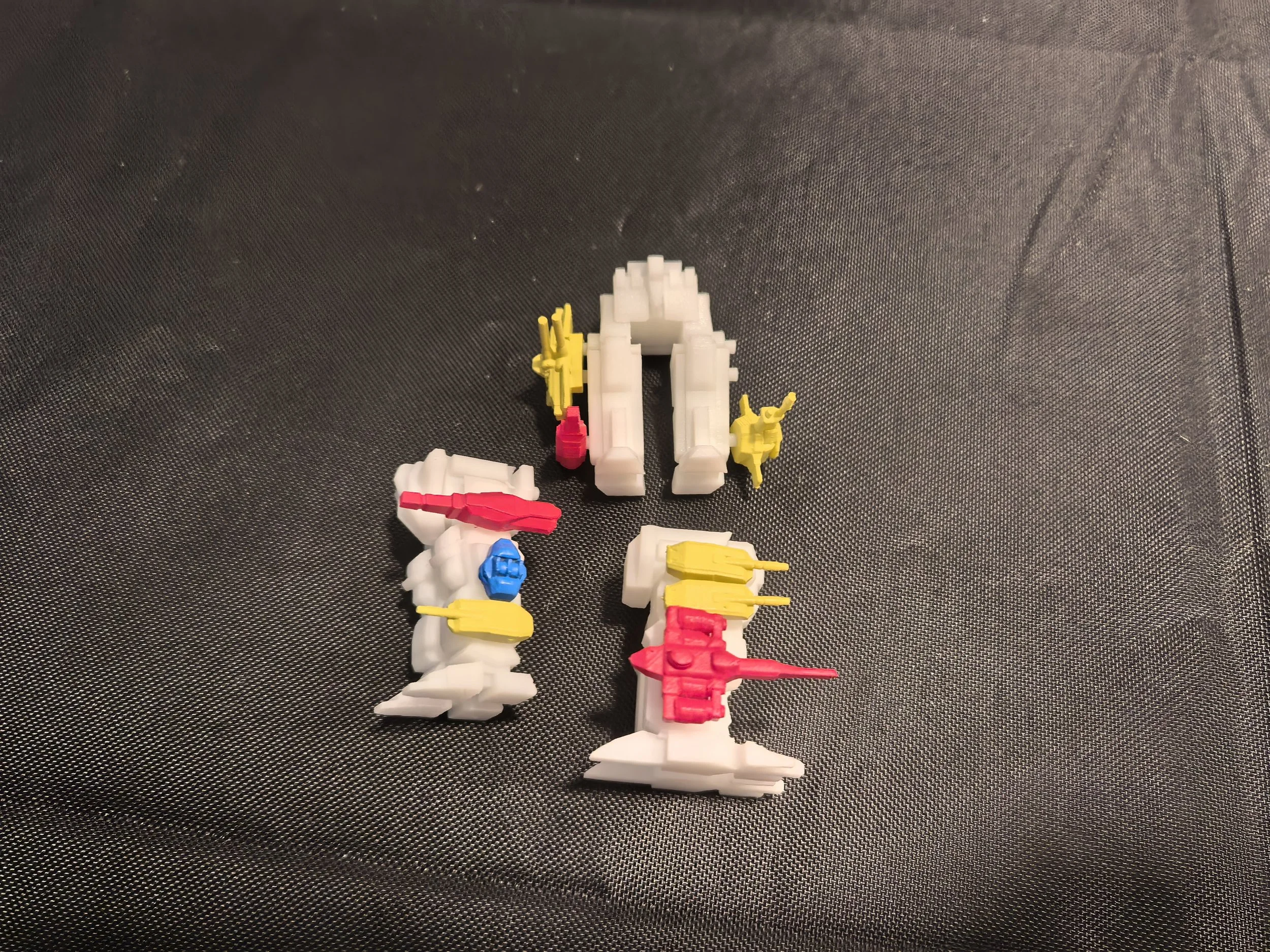
The distribution of mounting joints also varies for each structural component, so selecting the desired structural components at the outset is also important.
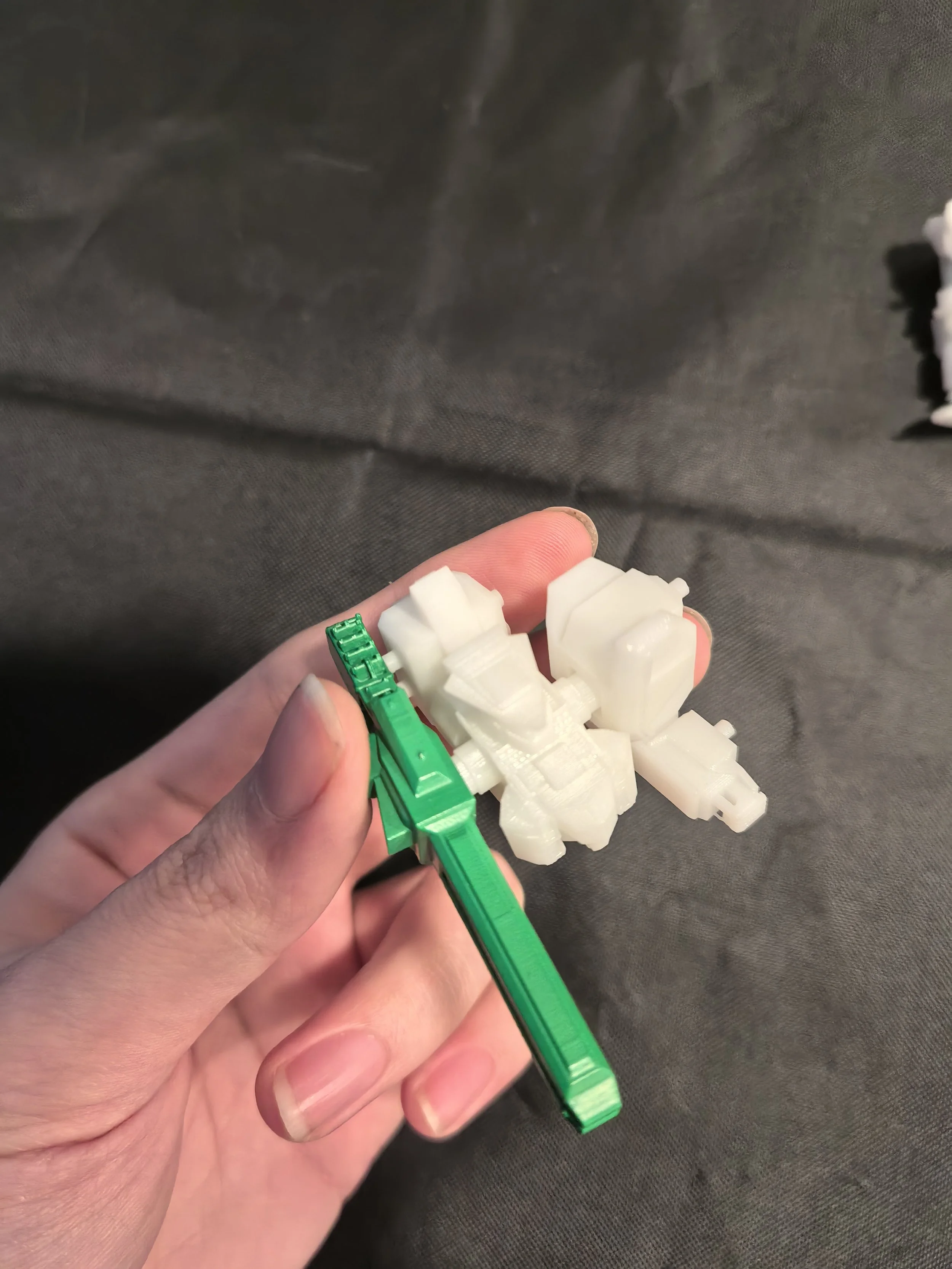
You can even choose to remove one of your arms to install these high-powered weapons.
VISUAL Design
ZERO MERIDIAN's visual language fuses two seemingly era-spanning design styles: the elegant geometry of Art Deco and the modern minimalism of Low Poly Art. I also select different color palettes for each card to highlight relevant resources. For other elements like token design and the tension progress bar, I also used a minimalist design approach.

This card's associated resource is “Fear,” and since “Fear” is a resource that can substitute for any other resource, I used a mix of the colors from the other three resources to illustrate it.

This card's associated resource is “Economy,” so its primary color is green.

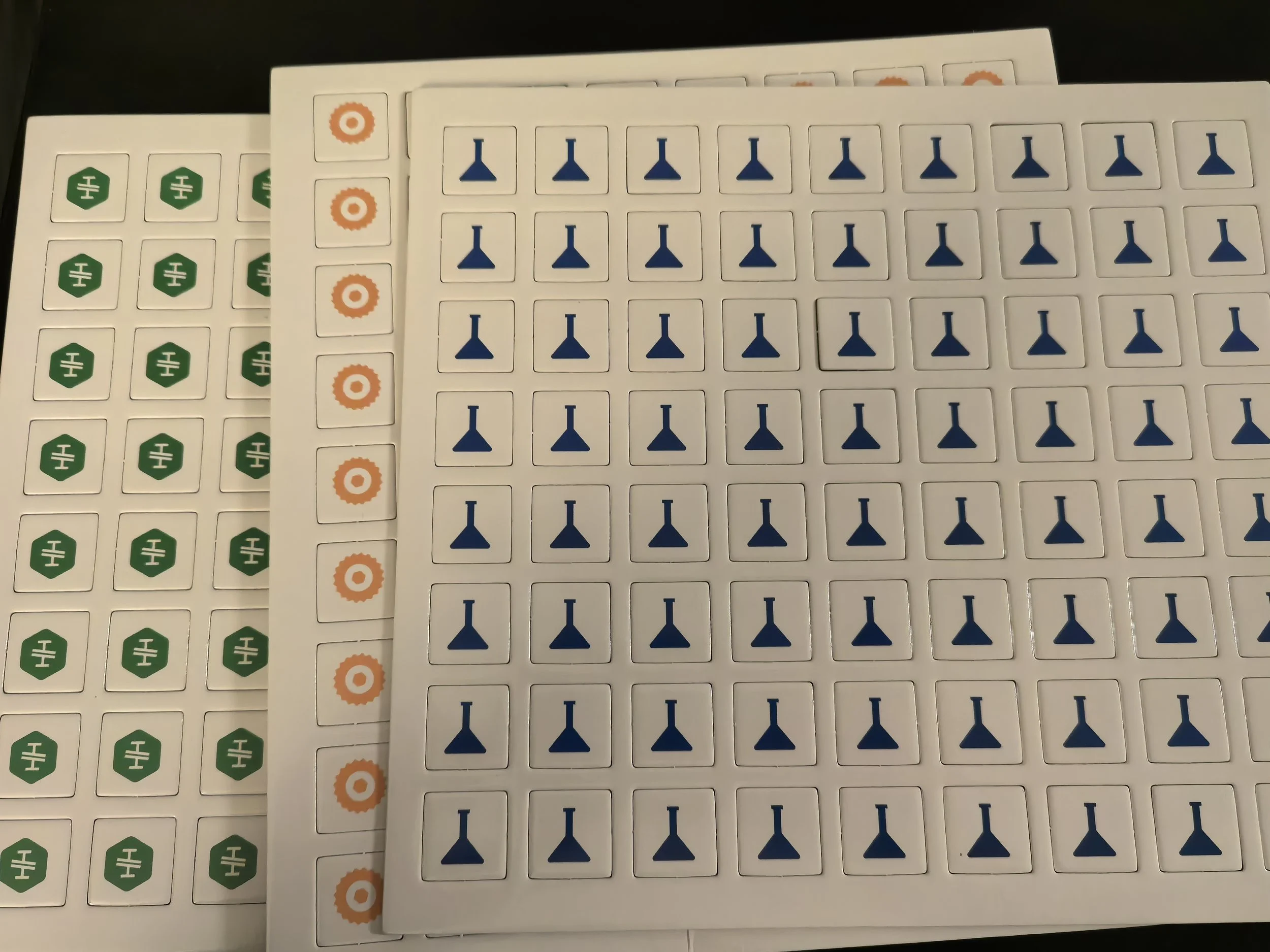
I personally love the design of my “economic” icon, which references the franc symbol.
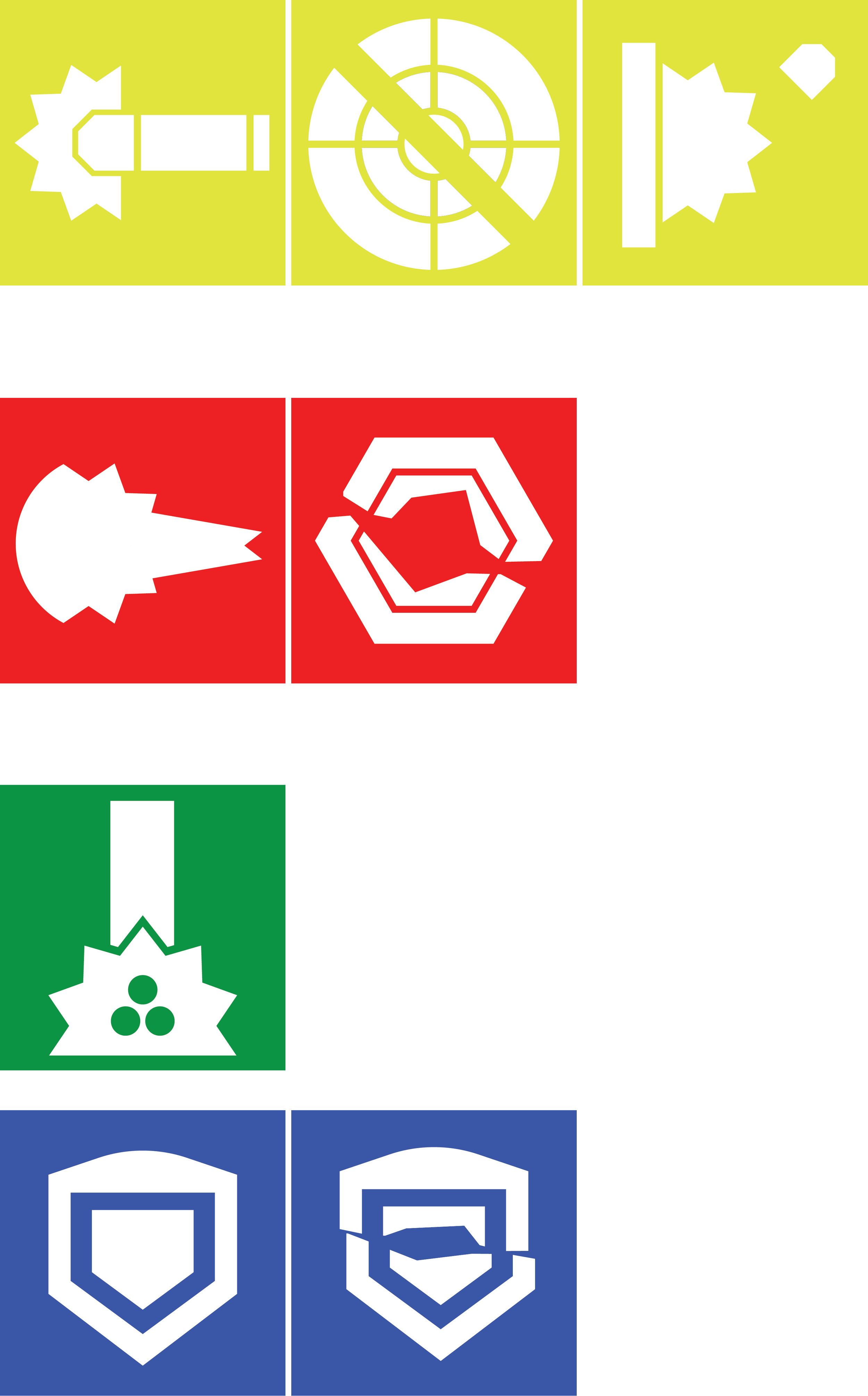
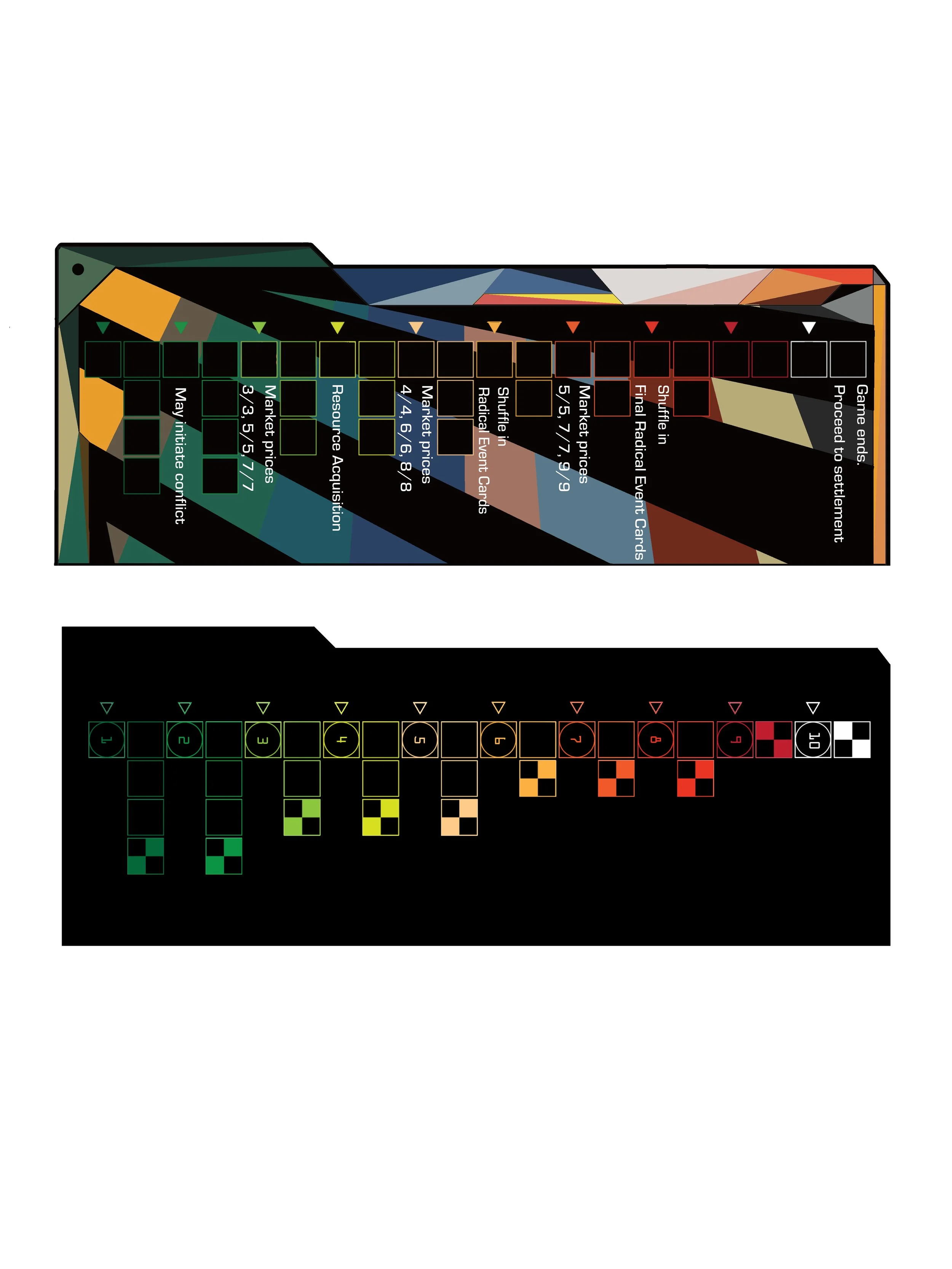
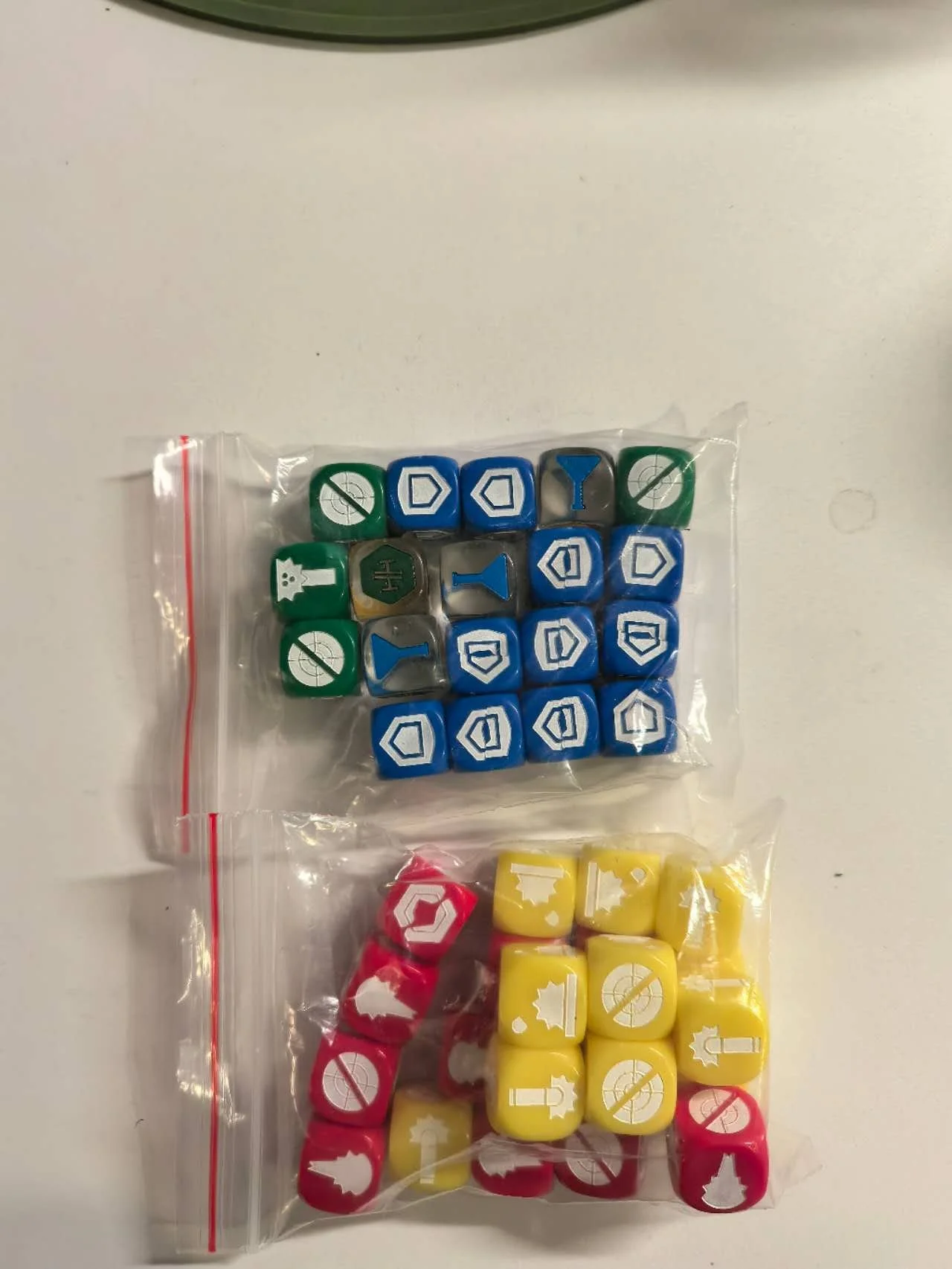
I've also designed the dice to be as visual and straightforward as possible, so players can instantly grasp their meaning at a glance.
3d model
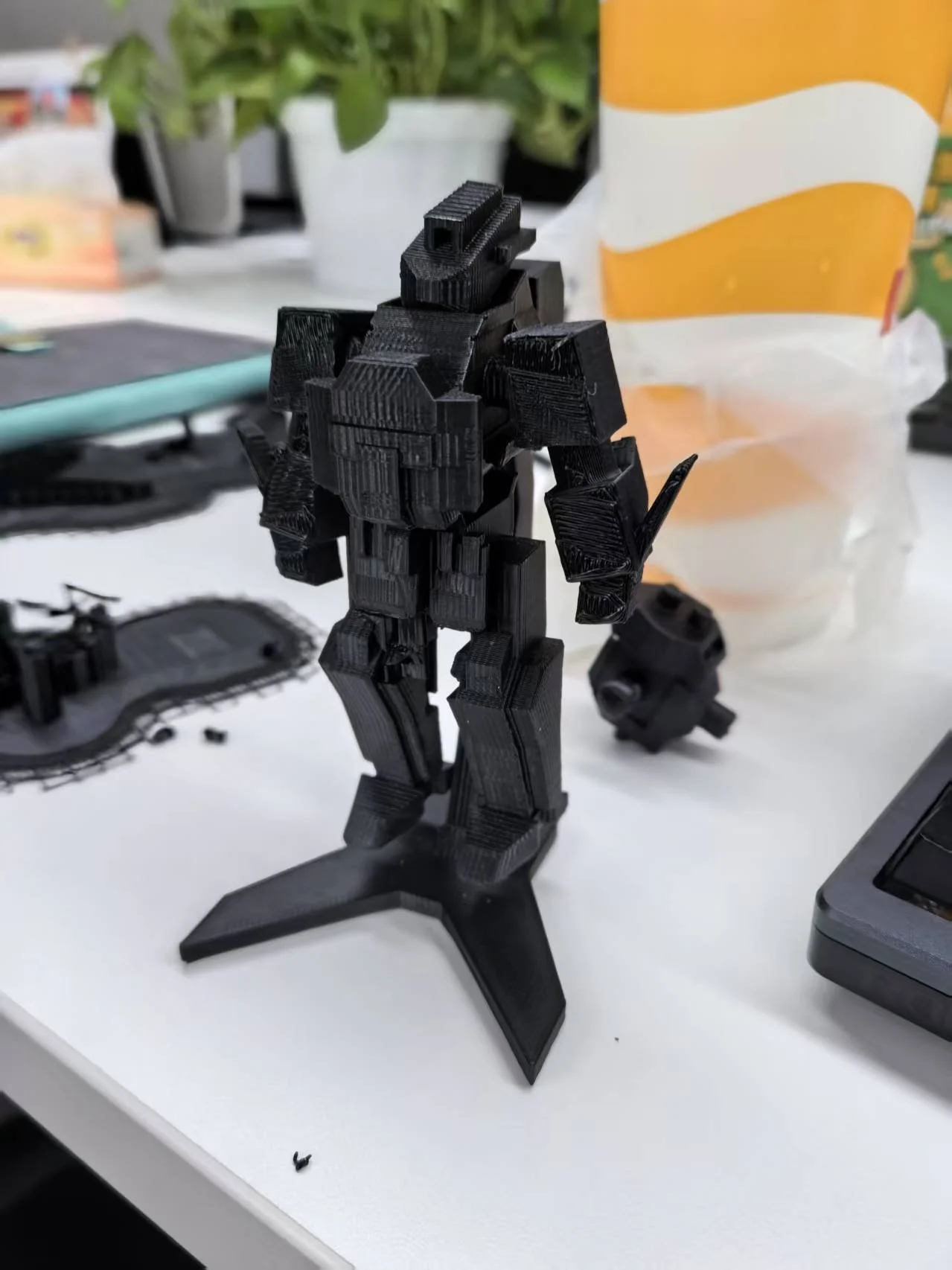
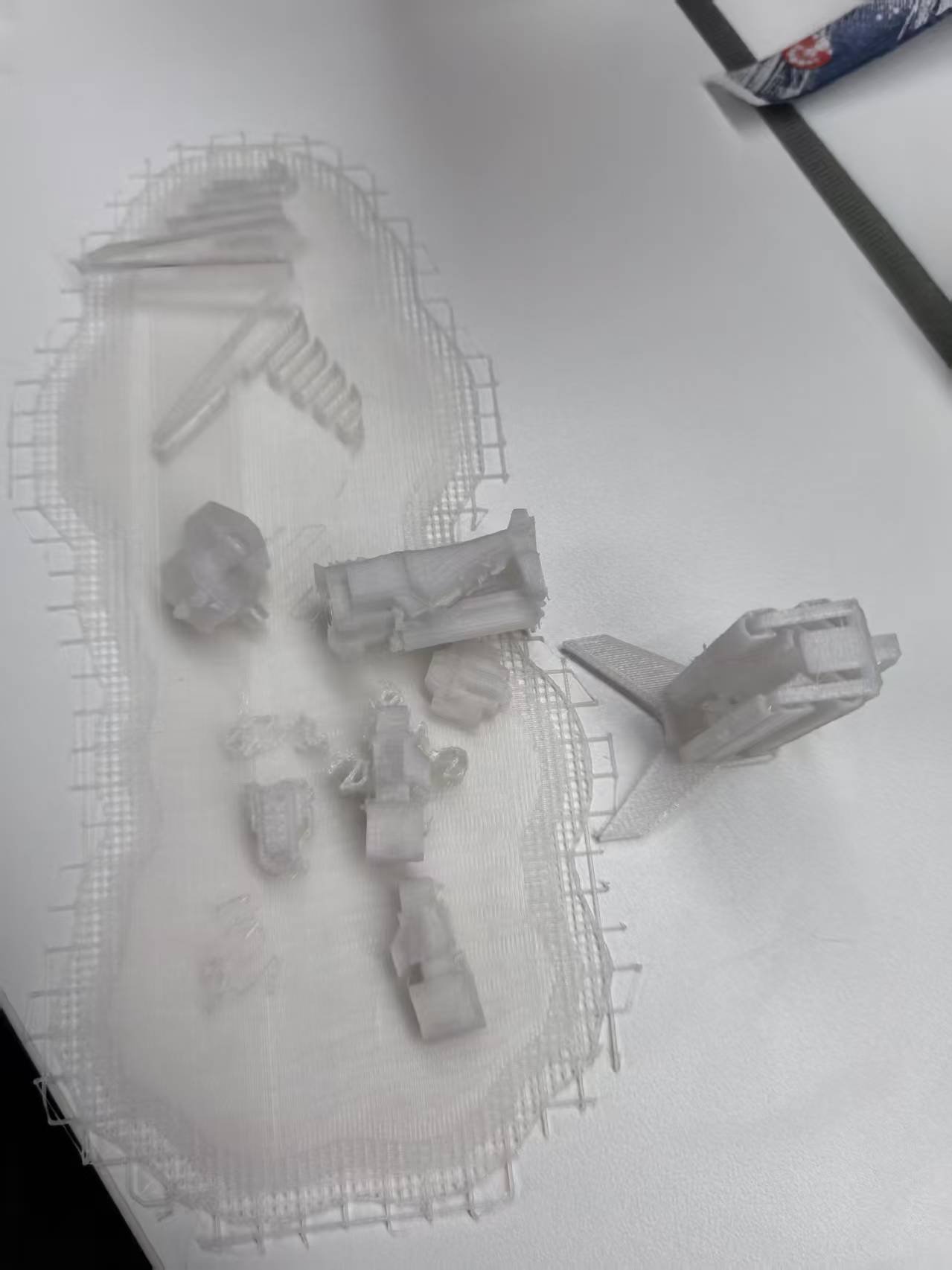
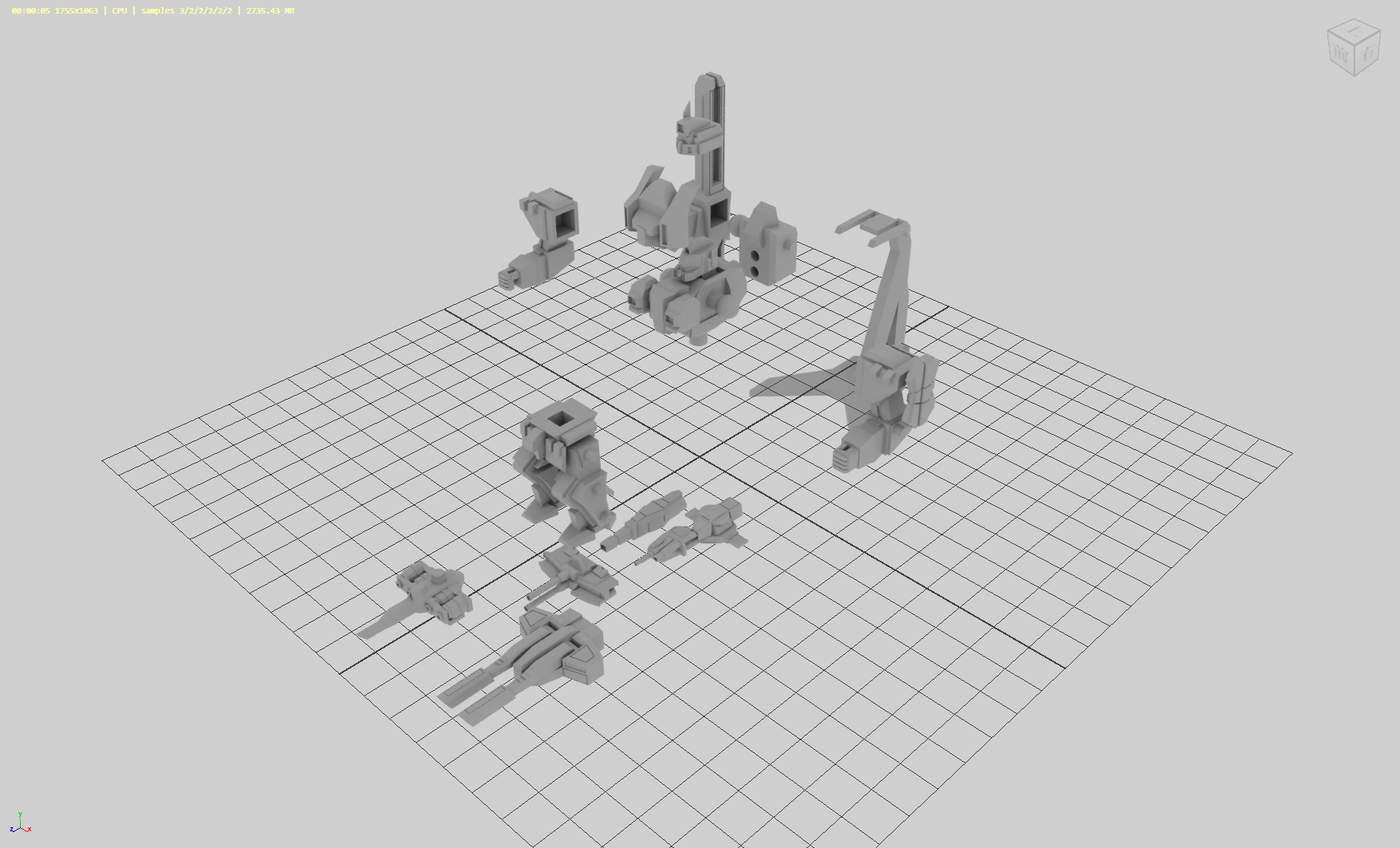
To create these assembleable models, I taught myself 3D modeling using Maya and printed my first prototype using a basic FDM 3D printer.
Initially, my vision was for the model to be crafted from materials similar to Gundam assembly gachapon capsules, as they offer flexibility and durability. However, I discovered that 3D-printed soft silicone is invariably too pliable. Achieving the desired hardness would require finding a plastic factory to print using PVC—a solution whose tooling costs would be astronomical for me. So I eventually decided to use FDM to print these models.
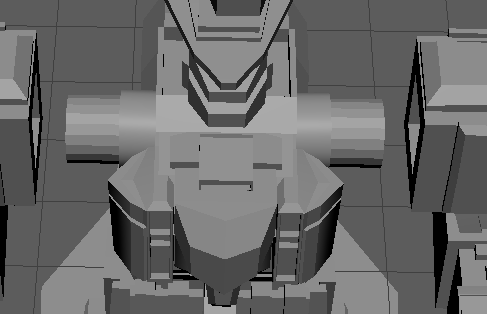
At first arms were connected using cylindrical joints like the one shown above. However, I discovered that the arms might obstruct certain leg attachments, preventing the installation of some weapons. Consequently, I ultimately switched to ball joints.
PRODUCTION


I used Clip Studio Paint and Illustrator to create all the art assets.
Then I used Tabletop Creator Pro to create all the cards.
All 3D models were created using Maya. And I found a 3D printing service online and had the 3D model printed.
I also found some custom dice and token manufacturers online and ordered custom dice, tokens, and cards.
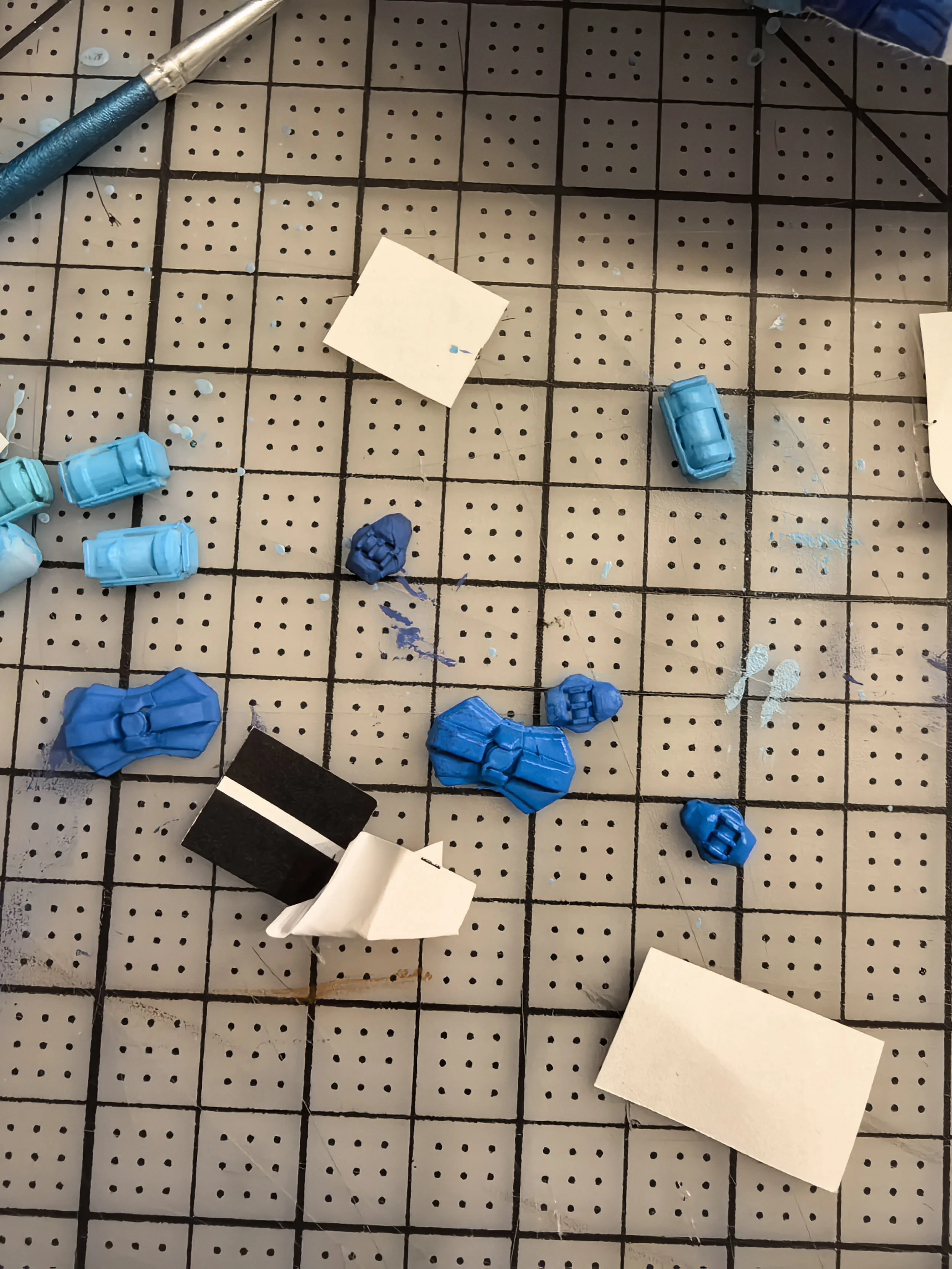
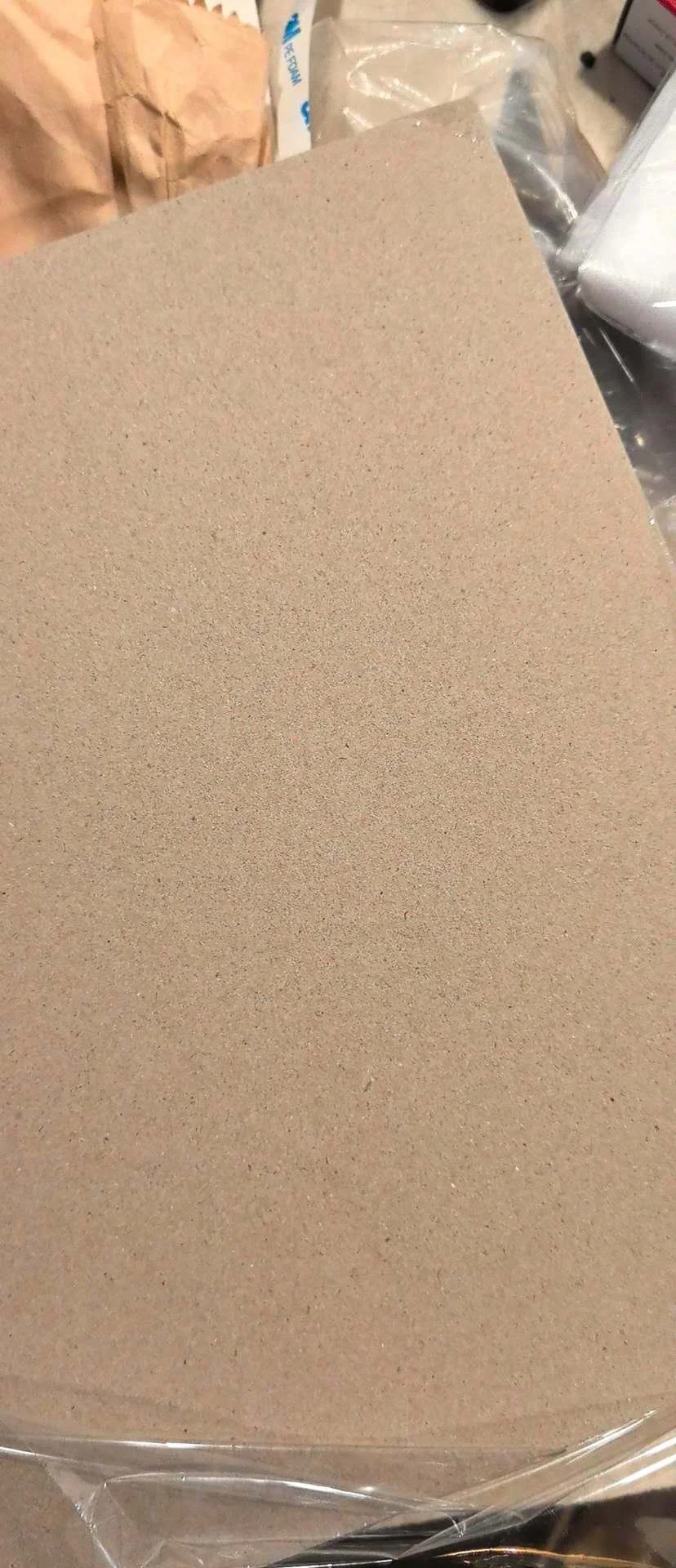
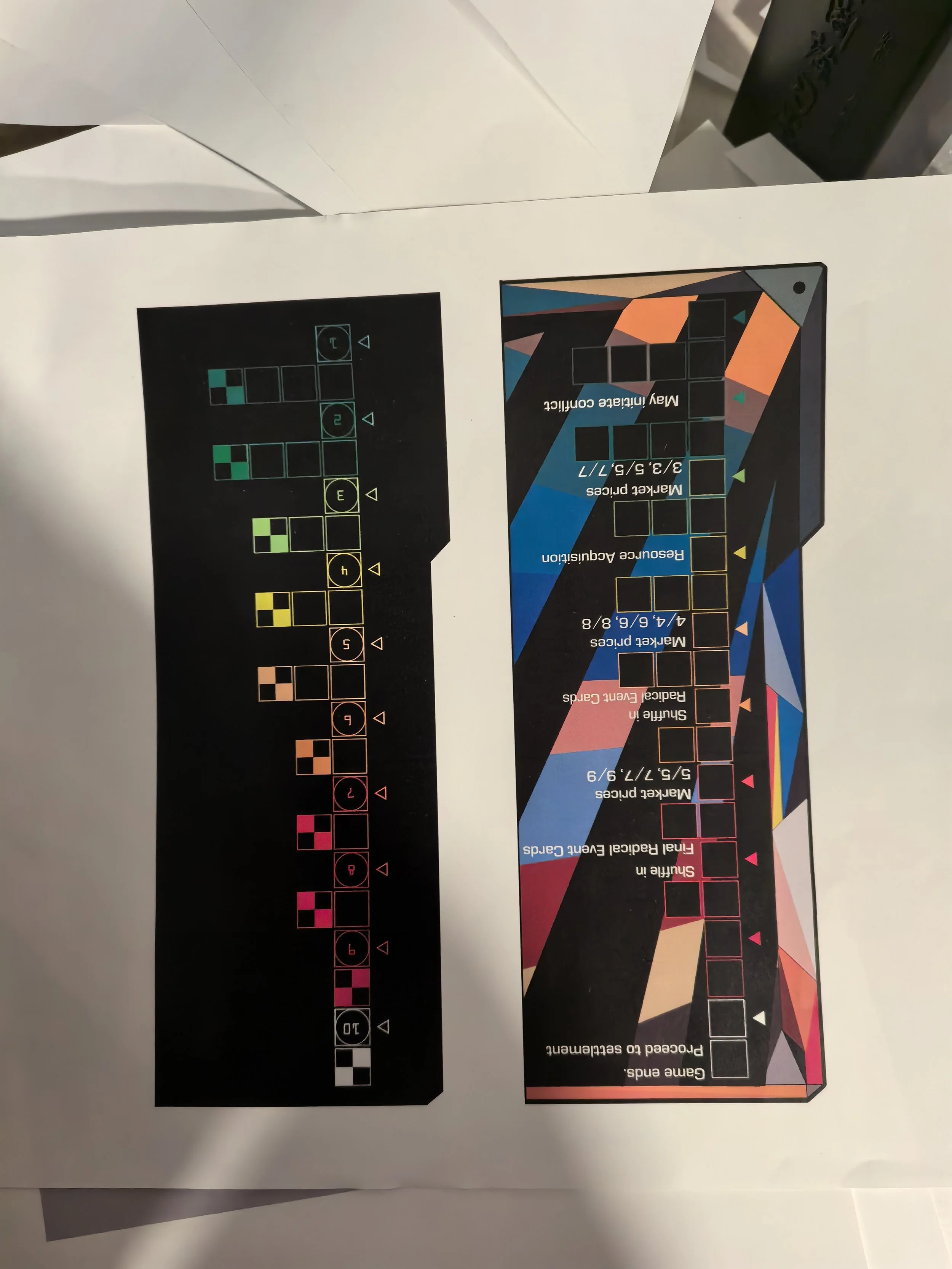
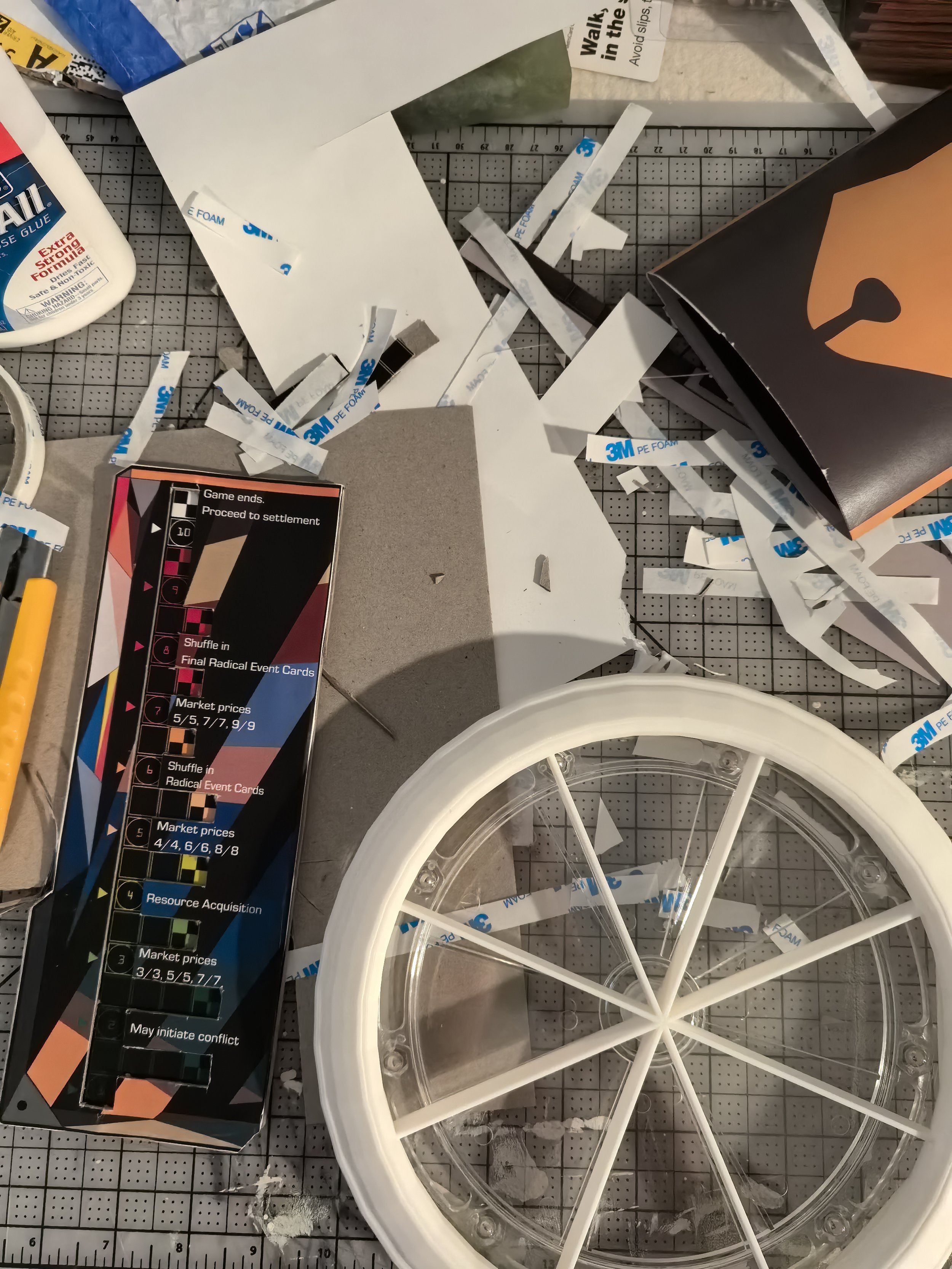
Then there's a lot of handcrafting and model painting. I'd like to say that while this part was challenging, the process was still quite interesting and helped me rediscover the joy of model-making.
playtest
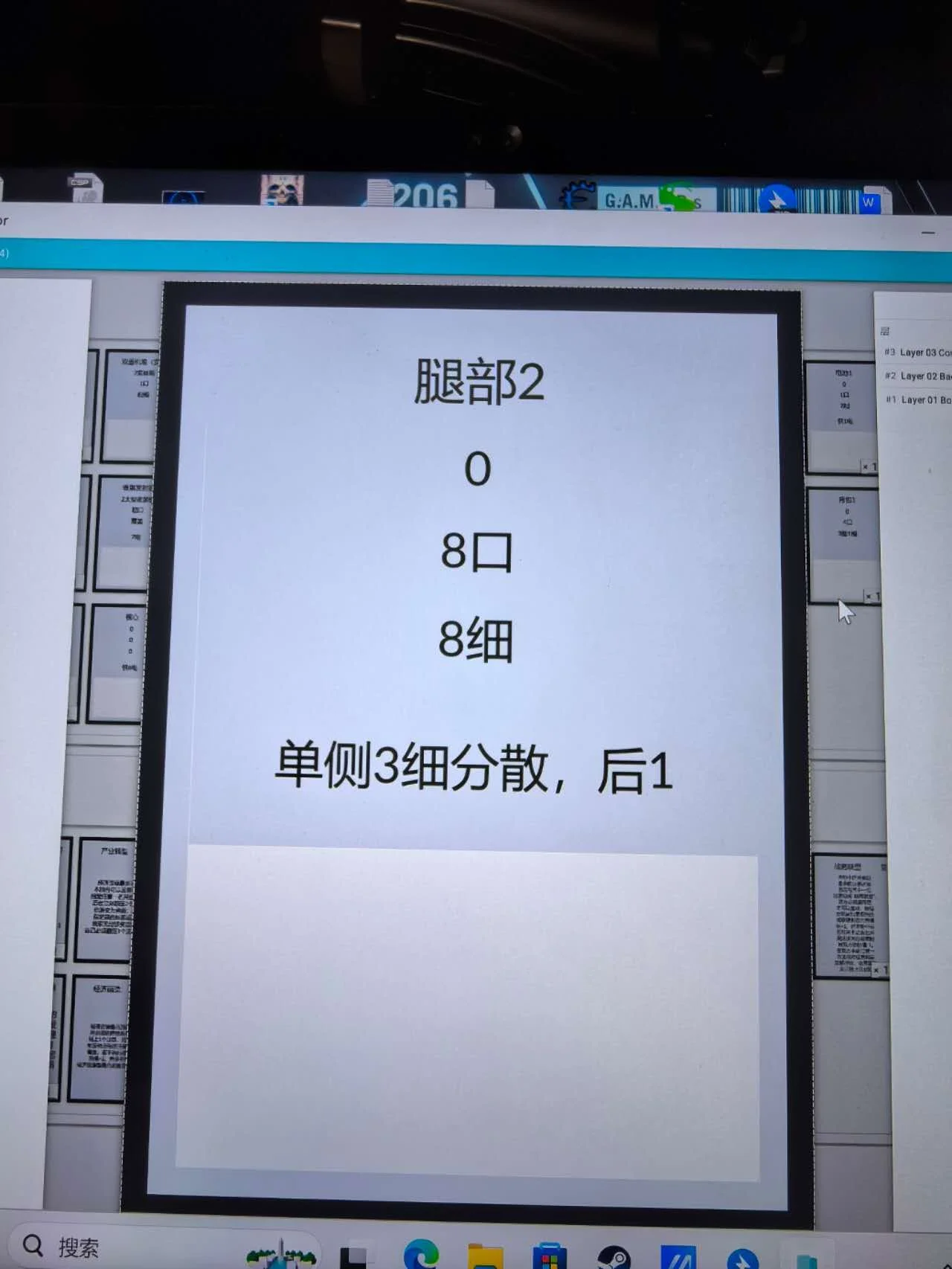
2025.08.23
I started by creating a paper prototype to test whether the game flow was going to work.
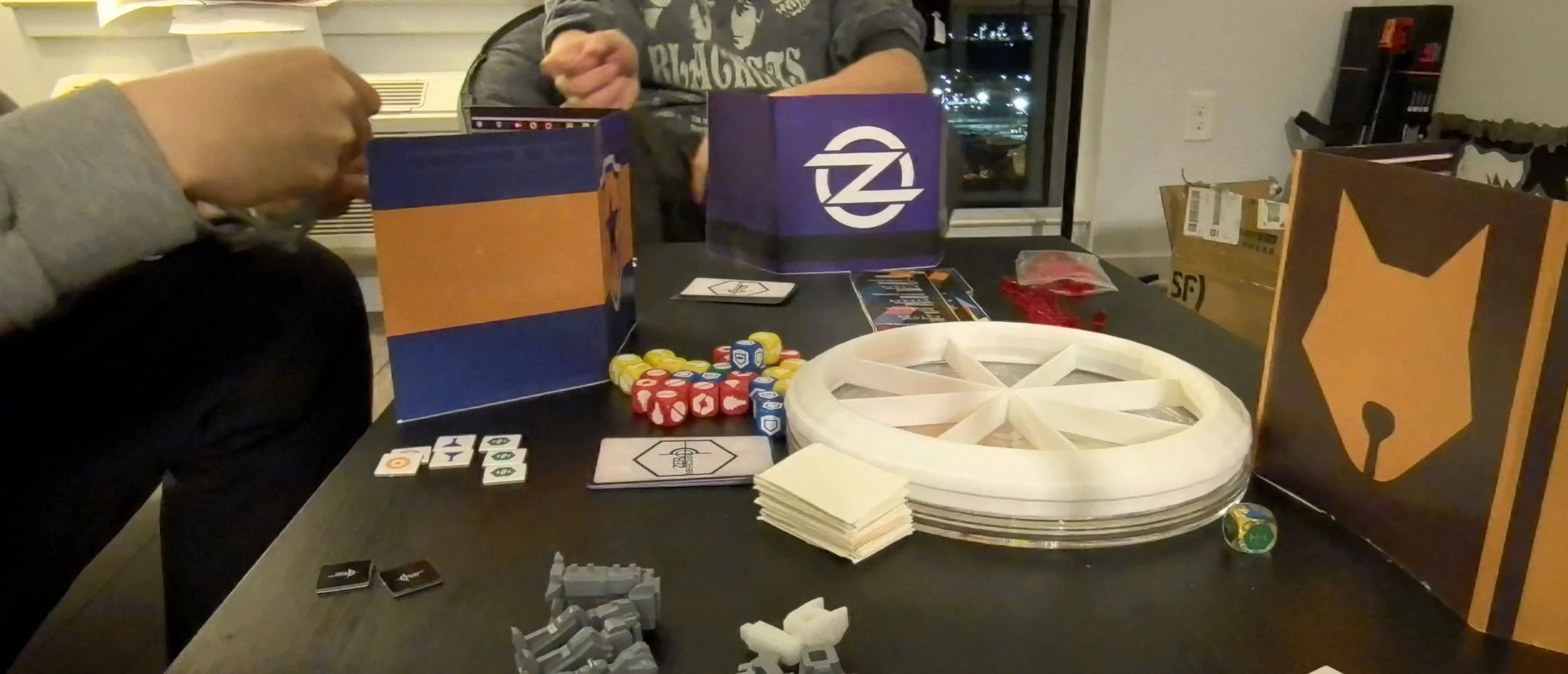
2025.10.18
A playtest was conducted with most components completed. During this test, I discovered that the tension escalated too rapidly, making it extremely difficult to assemble a heavily equipped mech within such a short timeframe.
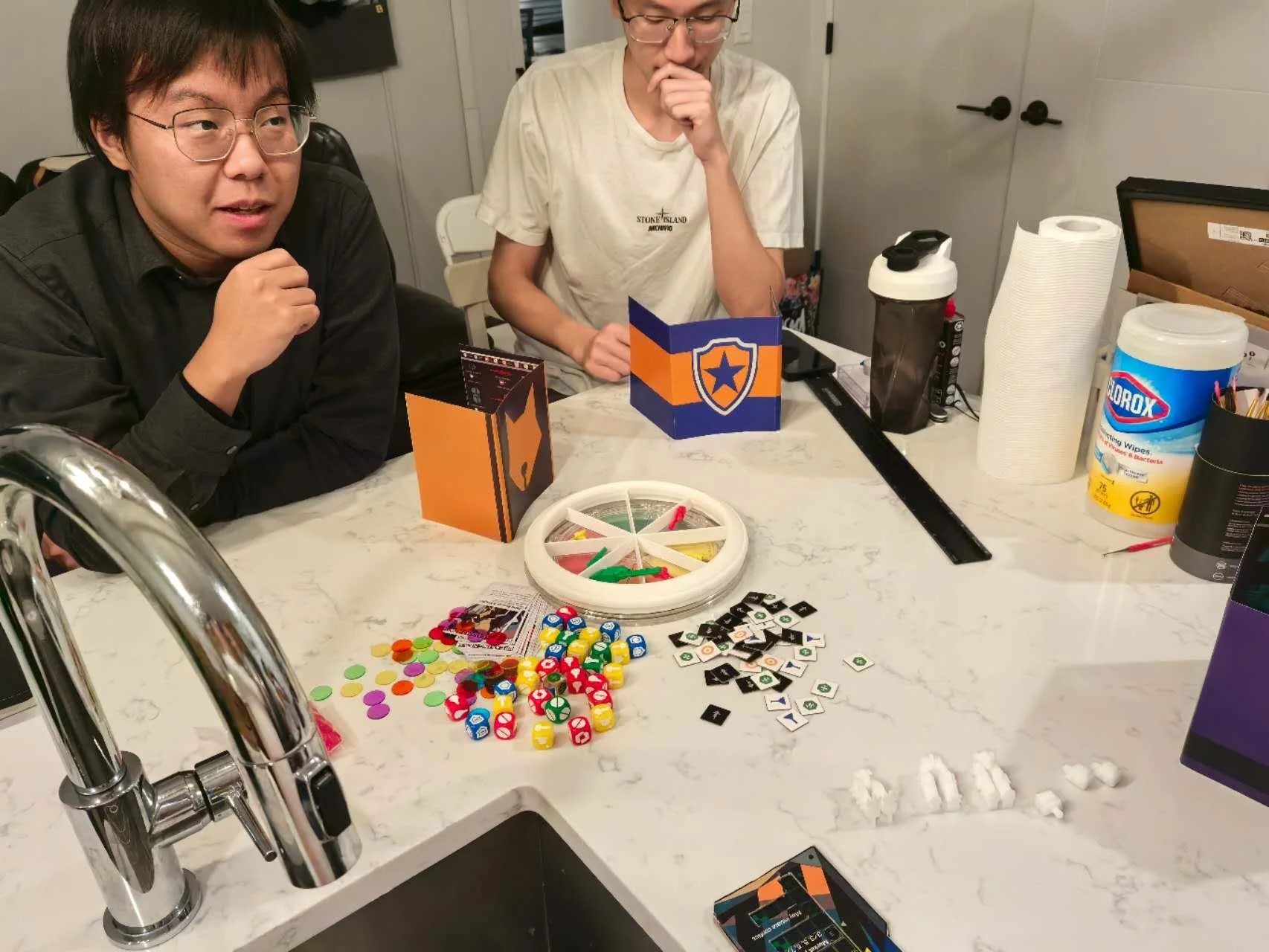
2025.11.01
During this playtest, I enlisted a friend who serves as president of their school's tabletop gaming club to test the game. I gained a wealth of valuable feedback, and I also discovered that adding a fourth player to act as the “market” significantly enhances the fun. Since the “market” player isn't concerned with winning or losing, their ability to freely select equipment and place it on the wheel adds a layer of “satire” toward the arms dealer—precisely the element I aimed to convey in this game. So I decided to make it into an expansion rule.
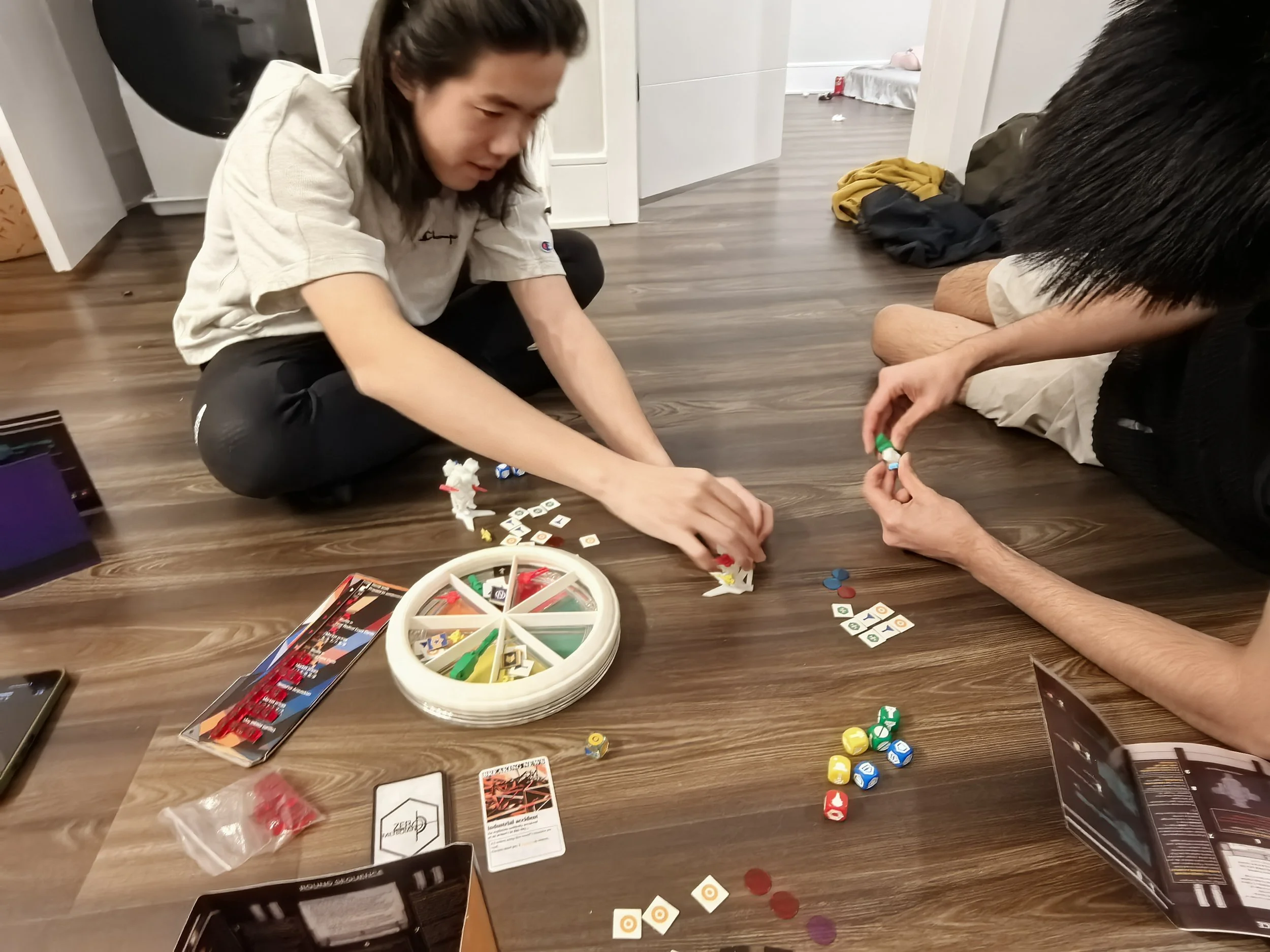
2025.11.09
In this test, I adjusted the initial resource quantities and added a feature to combat where resources are consumed to repair damaged equipment and reroll dice. The results exceeded my expectations—resources now feel more distinct from one another, and combat has gained an extra layer of fun.
What’s next
Assembly efficiency improvement
FDM printing still has considerable inaccuracies. I believe I can reduce this error by scaling up the model dimensions in the future.
Come up with a better way to randomly place equipment on the wheel.
Without using extension rules, the current random equipment selection method remains somewhat unfair due to significant size variations among items. I need to devise a way to ensure sufficient randomness—for instance, by creating a separate token for each piece of equipment and standardizing their sizes. However, incorporating too many components into the board game would make it overly complex.
Add more weapon and equipment types
I think the current variety of weapons and equipment is still somewhat limited and lacks sufficient diversity.
Attempt crowdfunding on Kickstarter and similar platforms (maybe)
I personally believe this project holds significant potential. There are few games on the market that primarily feature assembly mechanics. I think once it's further refined, we could explore crowdfunding options.